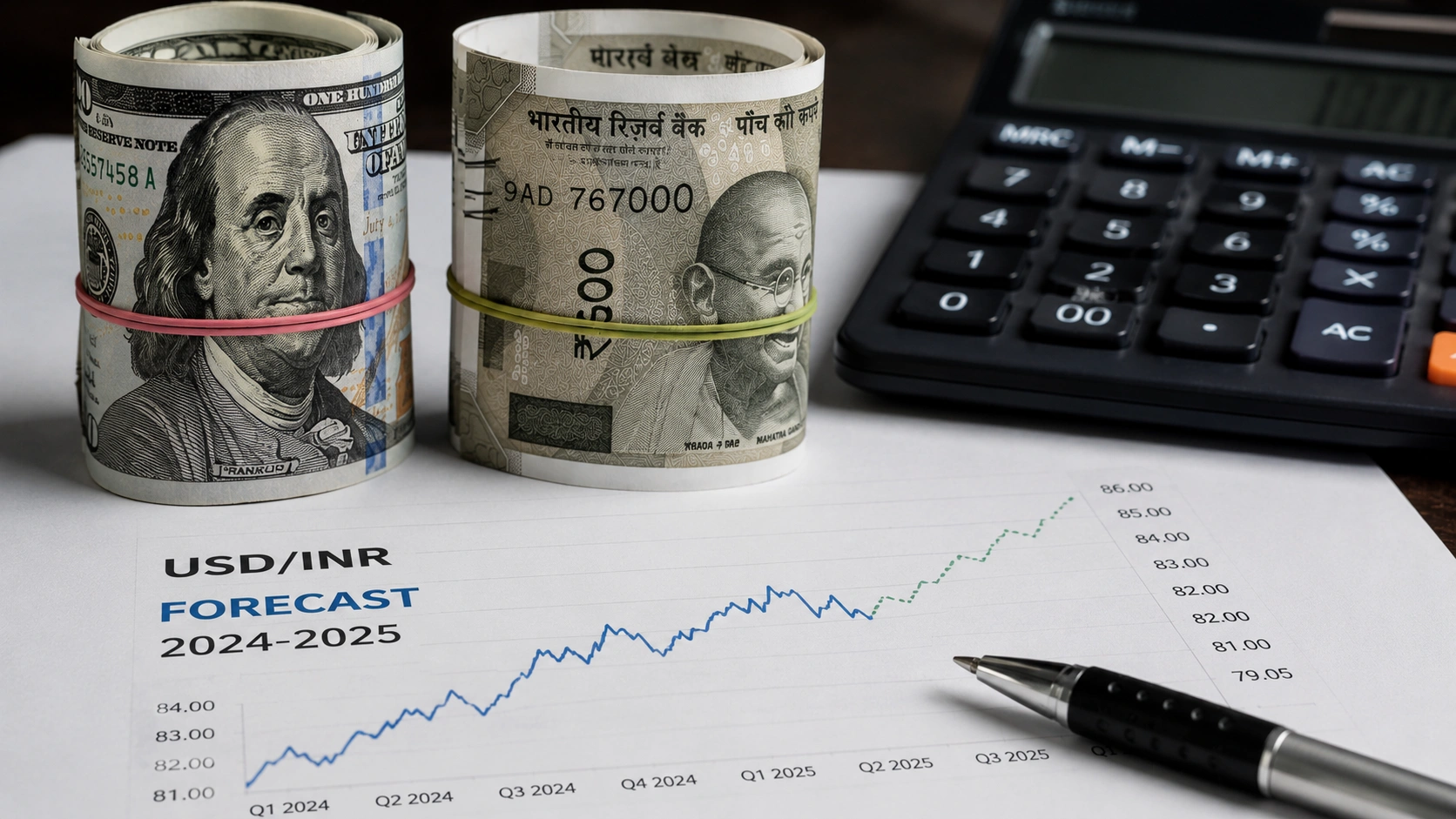
The USD/INR forecast is closely watched by investors, businesses, travelers, importers, exporters, and people sending money between the United States and India. The pair shows how many Indian rupees are needed to buy one U.S. dollar. As of August 25, 2026, the rupee was trading near ₹95.70 per dollar. Recent trading has remained unusually stable because the Reserve Bank of India has reportedly intervened in the foreign exchange market. However, stability does not mean the risks have disappeared. Oil prices, U.S. interest rates, foreign investment flows, inflation, and geopolitical tensions can all move the currency. A useful forecast should therefore focus on possible scenarios instead of promising one exact future rate.
The rupee has faced pressure from several external factors in 2026. Higher crude oil prices have increased India’s import costs, while global uncertainty has supported demand for the U.S. dollar. India imports more than 85% of its oil needs, making energy prices especially important for the rupee. At the same time, strong foreign currency inflows have provided support. Reuters reported that policy-driven inflows had reached almost $73 billion by August 2026, helping India’s foreign exchange reserves move close to a record level. These competing forces explain why the USD/INR outlook remains uncertain.
USD/INR Forecast for 2026
The near-term outlook remains sensitive to oil prices and central-bank policy. Reuters reported on August 24 that traders expected the rupee to remain in a relatively narrow range, supported by capital inflows and RBI intervention. The rupee had recently closed around ₹95.70 per dollar. Another Reuters report placed the near-term expected trading range around ₹95.50 to ₹96.50. These levels should not be treated as guaranteed boundaries. Currency markets can move quickly after major economic announcements. Still, they provide useful context for understanding current market expectations.
Forecasts for the end of 2026 differ among analysts. A Reuters poll published in July showed strategists expecting the rupee to remain relatively weak despite RBI measures designed to attract dollar inflows. The poll projected about ₹94.50 per dollar in three months and ₹95.90 in one year. Meanwhile, an aggregated forecast published in August showed a December 2026 USD/INR estimate near ₹95.46. The differences demonstrate an important point: currency forecasts are estimates, not fixed targets. New oil shocks, policy changes, or shifts in global investment can quickly change the outlook.
RBI Policy and the Indian Rupee
The Reserve Bank of India plays an important role in the USD/INR market. The central bank can influence liquidity, interest rates, foreign exchange conditions, and market volatility. Recent reports suggest that the RBI has actively intervened to limit excessive rupee weakness. Reuters reported that state-run banks appeared to offer dollars on behalf of the central bank as the rupee traded near ₹95.74. Such intervention can reduce short-term volatility. However, it does not eliminate the economic forces that create pressure on the currency.
RBI policy has also focused on improving India’s foreign currency position. The central bank introduced measures that encouraged foreign currency inflows, including a temporary swap facility for overseas deposits. Reuters reported that the measures attracted more than $50 billion and helped lift reserves above $700 billion. The facility was later ended earlier than originally planned. These developments give policymakers additional resources to manage market stress. For the USD/INR forecast, this means traders must watch both the underlying economic forces and the RBI’s response to them.
Oil Prices Could Be a Major USD/INR Driver
Crude oil is one of the most important factors for the rupee. India relies heavily on imported energy, so higher oil prices can increase the country’s demand for foreign currency. Importers need dollars to pay for crude, which can create additional demand for USD. If oil prices remain elevated for an extended period, they can therefore place pressure on INR. Reuters reported that Brent crude was around $92.30 per barrel on August 25 amid geopolitical concerns. This creates an important risk for the rupee outlook. For more: How to Trade Gold: A Beginner’s Guide
The relationship is not always straightforward. Lower oil prices can reduce India’s import bill and improve external conditions. That can support the rupee if other factors remain stable. However, oil prices can change quickly when supply disruptions or geopolitical tensions appear. Reuters recently noted that India’s heavy dependence on imported crude leaves the economy particularly exposed to disruptions in Middle Eastern oil supplies. Anyone following the USD/INR forecast should therefore monitor Brent crude alongside currency movements. Oil can sometimes explain a large part of the rupee’s short-term direction.
U.S. Interest Rates and USD/INR
Federal Reserve policy is another major factor in the dollar-rupee relationship. Higher U.S. interest rates can make dollar-denominated assets more attractive to global investors. This can increase demand for dollars and place pressure on emerging-market currencies. Lower U.S. rates can have the opposite effect when investors move toward higher-yielding assets elsewhere. Expectations often matter before an actual policy decision. Traders react to inflation data, employment reports, economic growth figures, and comments from Federal Reserve officials.
The interest-rate relationship also involves India. Investors compare expected returns in both markets when deciding where to allocate capital. If U.S. yields rise while Indian rates remain unchanged, the relative attraction of dollar assets can increase. If India’s rates rise or U.S. rates decline, the pressure can change. Recent market reports show that traders are watching both the Federal Reserve and RBI closely. This makes monetary policy one of the most important variables in any medium-term USD/INR forecast.
India’s Economic Growth and INR
India’s economic growth can support the rupee by attracting investment and strengthening domestic economic activity. Strong growth can encourage foreign investors to allocate capital to Indian companies, bonds, and other assets. Those investments can create demand for rupees. India has remained one of the world’s fastest-growing major economies despite recent external pressures. However, growth has shown signs of moderation. A Reuters poll published on August 25 estimated that India’s April-June 2026 growth slowed to 7.1% from 7.8% in the previous quarter.
Growth alone does not guarantee a stronger currency. Investors also consider inflation, imports, fiscal conditions, interest rates, and global risk sentiment. Strong domestic demand can support growth, but higher energy prices can raise costs at the same time. Reuters noted that India’s exports and consumer spending have provided resilience, while high oil prices and geopolitical uncertainty remain risks. Therefore, the economic outlook for India should be viewed as one part of a much larger USD/INR picture. The rupee’s direction depends on the balance between domestic strengths and external pressures.
Foreign Investment and the USD/INR Outlook
Foreign investment flows can create significant currency movements. When international investors buy Indian stocks or bonds, they often need rupees. This can increase demand for INR and support the currency. When investors sell Indian assets and move money abroad, they usually need dollars or another foreign currency. That can increase demand for USD/INR. Equity flows, bond investments, corporate borrowing, and foreign deposits can therefore influence the exchange rate.
Recent capital inflows have helped the rupee withstand several external pressures. Reuters reported that India’s policy-driven foreign currency inflows reached nearly $73 billion by August 2026. Strong inflows can provide the RBI with additional foreign exchange reserves and reduce immediate pressure on the rupee. However, capital flows can change direction quickly. Global investors may reduce emerging-market exposure during periods of financial stress. This is why the USD/INR forecast should always consider global investor sentiment rather than focusing only on India’s domestic economy.
USD/INR Forecast for 2027
Forecasts for 2027 show considerable uncertainty. BMI expects the rupee to weaken to around ₹97 per dollar by the end of India’s 2026–27 fiscal year and around ₹99 by the end of the following fiscal year. The firm cited elevated energy prices, global risk aversion, and less favorable interest-rate differences as factors that could pressure the rupee. This represents one scenario rather than a guaranteed outcome. If oil prices remain high and global investors favor the dollar, the rupee could face additional pressure.
Other forecasts are more moderate. MUFG’s August 2026 research expected USD/INR to move toward ₹94 before rebounding toward ₹96 in the following year. An aggregated forecast from Exchange Rates UK also showed the pair near ₹95.64 in March 2027 and about ₹95.72 in September 2027. The wide range between forecasts highlights the difficulty of predicting currencies several months ahead. For readers, the key takeaway is that a forecast should always be considered alongside its assumptions.
Bullish Scenario for the Indian Rupee
A stronger-rupee scenario could develop if several conditions improve at the same time. Lower crude oil prices would reduce India’s import costs. Strong foreign investment could increase demand for INR. A weaker U.S. dollar could also support emerging-market currencies. If inflation remains manageable, the RBI may have more flexibility in setting monetary policy. These factors could help USD/INR move lower, meaning fewer rupees would be required to buy one dollar.
A stronger rupee does not require every economic indicator to improve. Sometimes one major change can alter investor sentiment. For example, a sustained decline in oil prices could improve India’s external balance while reducing inflation pressure. Stronger capital inflows could then reinforce the move. However, investors should avoid assuming that one favorable development will create a permanent trend. Currency markets react to new information constantly. A bullish INR scenario is possible, but it remains dependent on global conditions.
Bearish Scenario for the Indian Rupee
A weaker-rupee scenario could emerge if oil prices remain high, global risk aversion increases, and the U.S. dollar strengthens. Geopolitical tensions could create additional demand for safe-haven dollar assets. Higher U.S. Treasury yields could also attract capital toward the United States. At the same time, strong importer demand could increase the need for dollars in India. These factors could push USD/INR higher.
The RBI can reduce excessive volatility, but it cannot permanently override economic fundamentals. Persistent external pressure could eventually require the exchange rate to adjust. Reuters reported that traders have recently expected RBI intervention to continue limiting the rupee’s losses. Yet traders are also watching whether the central bank’s support remains strong as oil and geopolitical risks evolve. This makes the bearish scenario important for businesses that depend on imported goods or dollar payments.
How Businesses Can Use the USD/INR Forecast
Businesses that import products into India often pay suppliers in U.S. dollars. A weaker rupee can therefore increase their costs. For example, an importer that must pay $1 million will need more rupees if USD/INR rises from ₹95 to ₹100. The difference would equal ₹5 million before considering other costs. Exporters can experience the opposite effect because they may receive dollars and convert them into rupees. Currency movements can therefore affect profit margins even when sales volumes remain unchanged.
Companies can manage this exposure through several financial tools. These may include forward contracts, options, and other hedging strategies. The appropriate choice depends on the company’s cash flow, risk tolerance, and financial structure. Small businesses may simply compare exchange quotes and time payments carefully. Larger companies often use formal treasury policies. A reliable USD/INR forecast can help with planning, but businesses should avoid relying on one target. Scenario planning can provide better protection against unexpected currency movements.
USD/INR Forecast: What Should Investors Watch?
Investors who follow the pair should monitor several indicators rather than one number. U.S. inflation and employment data can influence Federal Reserve expectations. Indian inflation and growth data can affect RBI policy. Brent crude provides clues about India’s import costs. Foreign portfolio flows can show whether international investors are increasing or reducing exposure to Indian assets. The U.S. Dollar Index can provide additional information about broader dollar strength.
Central-bank communication also matters. RBI intervention can temporarily reduce volatility, while Federal Reserve guidance can move the dollar rapidly. Recent Reuters reporting shows how strongly RBI action has affected USD/INR trading conditions. Investors should therefore combine economic data with market behavior. A forecast becomes more useful when it explains why a currency may move rather than simply providing a future number.
Frequently Asked Questions
What is the USD/INR forecast for 2026?
Current forecasts vary. Recent estimates range from modest rupee appreciation to further depreciation. BMI expects about ₹97 per dollar by the end of FY2026–27, while other forecasts are closer to the mid-₹90s.
Will USD/INR rise or fall?
There is no certain direction. High oil prices, strong dollar demand, and global risks could push USD/INR higher. Strong capital inflows, lower oil prices, and a weaker dollar could support the rupee.
Why is the Indian rupee weak against the dollar?
Several factors can contribute, including high oil prices, importer demand for dollars, foreign investment flows, U.S. interest rates, and global risk sentiment. India’s heavy dependence on imported oil makes energy prices especially important.
What could make USD/INR fall?
Lower oil prices, stronger foreign investment, a weaker U.S. dollar, improved global sentiment, and stronger Indian external conditions could support INR and push USD/INR lower.
Is USD/INR expected to reach ₹100?
Some analysts see further rupee depreciation as possible, but ₹100 is not a guaranteed target. BMI expects ₹99 per dollar by the end of FY2027–28. Future oil prices, capital flows, RBI policy, and global conditions will determine the actual rate.
Conclusion
The USD/INR forecast remains highly dependent on global and Indian economic conditions. The rupee is currently trading near ₹96 per dollar, while RBI intervention and strong foreign currency inflows have helped limit short-term volatility. At the same time, high oil prices, geopolitical risks, importer dollar demand, and changing U.S. interest-rate expectations continue to create pressure.
There is no single exchange-rate target that can reliably predict the future. Some forecasts point toward further rupee weakness, while others expect a more stable range. For anyone tracking the pair, the best approach is to monitor RBI policy, Federal Reserve decisions, crude oil prices, inflation, economic growth, and foreign investment flows. Checking updated forecasts as new economic data arrives can help you make better-informed currency decisions.