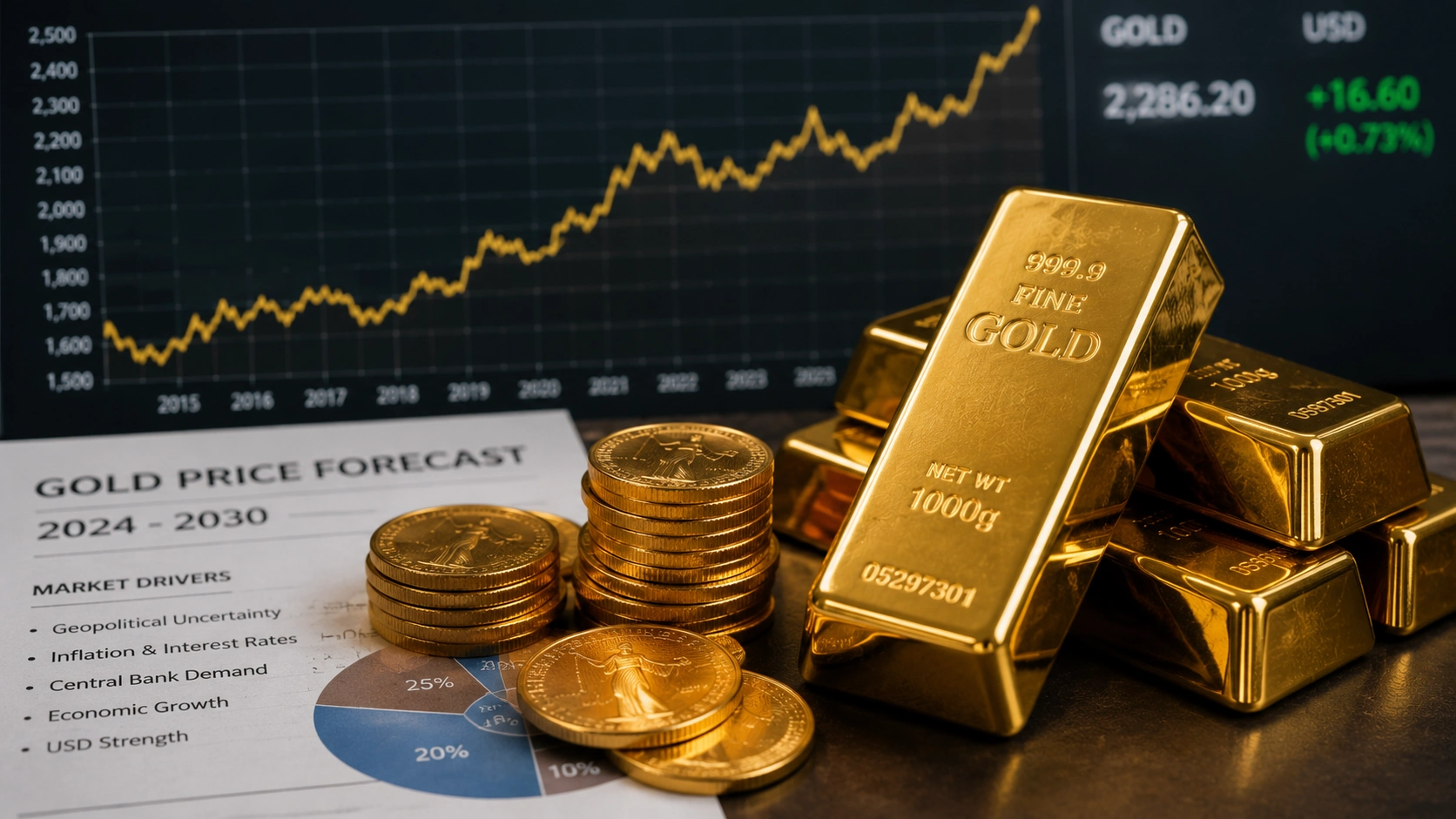
The gold price forecast 2030 is attracting strong interest from investors, savers, and people who use gold as a long-term store of value. Gold has already experienced major price movements in recent years, supported by central bank buying, geopolitical uncertainty, investment demand, and changing interest-rate expectations. The World Gold Council reported that gold reached more than 12 all-time highs during the first half of 2026 and briefly moved above $5,500 per ounce before a sharp correction. These movements show why long-term predictions require caution. No analyst can know the exact gold price in 2030. Instead, investors can examine economic trends, central bank purchases, inflation, interest rates, global growth, and investor demand to understand the possible direction.
Gold has a special position in global markets because people treat it as both a financial asset and a physical commodity. Investors often buy it during periods of uncertainty, while central banks hold it as part of their reserves. Jewelry remains another major source of demand. Gold also has applications in technology and other industries. The World Gold Council’s long-term research argues that gold prices reflect both global economic growth and the size of financial markets over longer periods. This makes a 2030 forecast more complicated than simply looking at today’s price. A useful outlook must consider several forces at the same time and recognize that unexpected economic or geopolitical events can change the market quickly.
Gold Price Forecast 2030: Why the Outlook Matters
The long-term gold outlook matters because gold can behave differently from stocks, bonds, currencies, and other traditional investments. During periods of market stress, investors may increase their gold exposure because they want an asset that does not depend directly on the financial health of one company or government. Gold can also benefit when investors expect lower real interest rates or higher inflation. These relationships are not guaranteed, but they have influenced gold prices throughout different market cycles. The World Gold Council’s long-term research found that gold has historically delivered returns above inflation over extended periods. That does not guarantee similar performance through 2030, but it helps explain why investors continue to consider gold in long-term portfolios.
The current market also demonstrates how quickly gold expectations can change. The World Gold Council reported that gold reached a record above $5,400 per ounce in January 2026 before falling toward $4,000 in June. Such a large move within months shows why investors should avoid treating a single price target as certain. A long-term forecast should instead consider several possible outcomes. A bullish environment could involve falling interest rates, strong central bank purchases, geopolitical risks, and continued investment demand. A weaker environment could involve stronger economic growth, higher yields, a stronger dollar, and reduced demand for safe-haven assets. These scenarios provide a more realistic framework for thinking about gold in 2030.
Central Bank Demand and Gold Prices
Central bank purchases have become one of the most closely watched factors in the gold market. Governments hold gold as part of their reserves, and their buying decisions can influence physical demand. Strong central bank demand can also signal confidence in gold as a long-term reserve asset. The World Gold Council expects central bank buying to remain an important factor in the gold market. Its 2026 outlook notes that geopolitical risks continue to support central bank net buying, along with demand from gold-backed exchange-traded funds and physical bars and coins. Continued official-sector demand could therefore provide structural support for gold through the end of the decade.
However, central bank demand can change. Governments may increase purchases when they want greater reserve diversification, but they can also slow buying when prices rise sharply or economic conditions change. This creates uncertainty for a 2030 forecast. If central banks continue accumulating gold at strong levels, the additional demand could help support prices during periods of weakness. If buying slows considerably, the market could become more dependent on private investors, jewelry demand, and broader financial conditions. Investors should therefore watch official gold-purchase data rather than assume that recent buying trends will continue at the same pace. A strong forecast should always account for the possibility of changing central bank behavior.
Inflation and the Gold Price Forecast 2030
Inflation is one of the most common reasons investors consider gold. When consumer prices rise, people often look for assets that may preserve purchasing power over long periods. Gold has developed a reputation as a store of value because it is scarce and cannot be created through ordinary monetary policy. However, the relationship between inflation and gold is not automatic. Gold can fall even when inflation remains elevated if interest rates rise sharply or investors prefer other assets. The broader financial environment matters just as much as the inflation number itself.
The long-term role of inflation still deserves attention when considering 2030. The World Gold Council’s research suggests that gold’s long-term performance has historically remained above inflation and has been closely connected with global economic expansion. If inflation remains higher than expected over the coming years, gold could benefit from renewed demand for purchasing-power protection. On the other hand, successful inflation control could reduce some of that demand. Investors should therefore watch both inflation and real interest rates. A period of falling inflation combined with strong economic growth may create a very different environment from one marked by persistent inflation and weak growth.
Interest Rates, the Dollar, and Gold
Interest rates can have a major effect on gold because the metal does not pay interest. When government bonds and other interest-bearing assets offer attractive real returns, investors may have less reason to hold gold. When real yields fall, gold can become more competitive. Expectations about central bank policy can therefore move gold prices even before policymakers actually change rates. The U.S. dollar also matters because gold is normally quoted in dollars. A stronger dollar can make gold more expensive for international buyers, while a weaker dollar can provide support under certain conditions. For more: How Much Money Does Elon Musk Make a Day?
The 2026 market offers a clear example of this relationship. The World Gold Council noted that changes in rate expectations and the U.S. dollar contributed to gold’s sharp movements during the first half of the year. This does not mean gold always moves opposite to rates or the dollar. Other forces can dominate, especially during periods of geopolitical stress. For a 2030 forecast, investors should therefore monitor U.S. monetary policy, inflation expectations, Treasury yields, and dollar trends together. Looking at only one indicator can produce an incomplete view of the market.
Gold Price Forecast 2030: Bullish Scenario
A bullish gold price forecast 2030 would require several supportive conditions. One possibility involves persistent geopolitical uncertainty, strong central bank purchases, lower real interest rates, and continued investor demand. Another could involve a period of economic weakness that encourages investors to seek defensive assets. Under such conditions, gold could attract money from investors who want diversification and protection from financial volatility. Exchange-traded funds, physical bars, and coins could all contribute to stronger investment demand. The World Gold Council’s 2026 research shows that geopolitical risk and investor positioning can produce powerful movements in gold prices.
A more extreme bullish scenario could develop if several risks appear together. Imagine global growth slows, inflation remains difficult to control, and geopolitical tensions increase at the same time. Central banks could respond with easier monetary policy, while investors could increase their gold holdings. Such a combination could create substantial upward pressure. However, even a strong bullish case would not mean gold rises every year. Gold can experience major corrections after powerful rallies. The 2026 decline from above $5,500 to below $4,000 demonstrates this risk clearly. Investors should therefore view bullish forecasts as possible paths rather than guaranteed outcomes.
Gold Price Forecast 2030: Bearish Scenario
A bearish scenario would involve stronger economic growth, declining geopolitical risks, controlled inflation, and relatively high real interest rates. In that environment, investors could favor stocks and bonds over gold. A stronger U.S. dollar could create additional pressure. Lower demand from exchange-traded funds and private investors could then weaken the investment side of the market. Jewelry demand could also suffer if gold prices remain very high. The World Gold Council has noted that high gold prices can put pressure on jewelry consumption. These factors could create periods when gold trades significantly below optimistic long-term forecasts.
Gold supply could also respond to high prices. Mining companies have stronger incentives to develop projects when gold prices remain attractive. Recycling can increase as consumers sell old jewelry and other gold items. The World Gold Council expects mine supply to edge higher in response to elevated prices and margins. Greater supply does not guarantee lower prices, but it can reduce some pressure created by strong demand. A bearish 2030 environment would therefore combine softer investment interest with stronger supply and a healthier global economy. Even then, geopolitical shocks could quickly change market sentiment and interrupt a longer-term downtrend.
What Could Gold Be Worth in 2030?
There is no single reliable number for the gold price in 2030. Long-term forecasting becomes increasingly difficult because small changes in economic assumptions can produce large differences over several years. The World Gold Council’s long-term model offers an interesting framework rather than a simple price target. Its research estimates an average annual gold return of about 5.2% for 2025 through 2040 under its model assumptions. That estimate should not be interpreted as a guaranteed annual return. It represents one model based on expected global GDP growth and financial-market conditions.
For investors, scenario analysis is more useful than choosing one precise number. A conservative case could assume stable inflation, strong economic growth, higher real yields, and moderate central bank demand. A base case could include steady economic expansion, ongoing official-sector buying, and periodic geopolitical risks. A bullish case could involve weaker growth, lower rates, persistent inflation concerns, and strong investment flows. These scenarios can produce very different 2030 outcomes. Anyone researching the gold price forecast 2030 should therefore ask what assumptions support a particular target. A forecast without clear assumptions tells investors very little about how reliable the number might be.
Gold Supply and Mining Outlook
Gold supply is another important part of the long-term forecast. Unlike currencies, gold cannot be produced by central banks. New supply comes mainly from mining and recycling. Mining projects often require significant capital and years of development. Companies must explore deposits, obtain permits, build infrastructure, and begin production. These limitations can make gold supply relatively slow to respond to changes in demand. The World Gold Council has previously highlighted the challenge facing the mining industry as it attempts to maintain production over the coming decades. This structural issue could support prices if demand remains strong.
Recycling provides a more flexible source of supply. When gold prices rise significantly, households and businesses may have greater incentives to sell old jewelry, industrial material, and other gold items. This can increase the amount of metal returning to the market. The World Gold Council expects recycling to increase somewhat during 2026, although high prices have also affected jewelry demand. By 2030, improvements in recycling technology could provide additional supply. Mining discoveries could also change the long-term balance. These factors make supply an important variable in any serious forecast. Strong demand alone does not guarantee unlimited price growth.
Global Economic Growth and Gold
Global economic growth has a deeper relationship with gold than many short-term forecasts suggest. Gold is held by households, investors, central banks, and financial institutions around the world. As global wealth expands, the amount of capital available for gold investment can also increase. The World Gold Council’s long-term research identifies global nominal GDP and global financial-market capitalization as key drivers of gold’s long-term price behavior. This provides a useful framework for understanding why gold can maintain long-term value even when short-term market conditions change.
Economic growth can affect gold in several different ways. Strong growth can increase household wealth and investment capacity. It can also support jewelry consumption in emerging markets. India and China remain particularly important because of their large populations and established gold markets. The World Gold Council has previously highlighted the growing middle class in both countries as a long-term source of gold demand. At the same time, strong growth can raise interest rates and reduce demand for defensive assets. This creates a balance between positive wealth effects and potentially negative opportunity costs. The final impact depends on the wider economic environment.
Should You Invest in Gold for 2030?
Gold can play several roles in a long-term portfolio. Some investors use it as a hedge against uncertainty, while others hold it for diversification or as a store of value. Physical gold can provide direct ownership, but it may involve storage, insurance, and dealer costs. Gold-backed exchange-traded products can provide easier market access, but investors need to understand their fees and structure. Mining companies offer another form of exposure, although their share prices depend on business costs, management, debt, and broader equity-market conditions. These differences matter when deciding how gold fits into a personal investment strategy.
A long-term investor should avoid building an investment plan around one gold price target. Forecasts can change when inflation, interest rates, currencies, and geopolitical conditions change. A diversified strategy can reduce the risk of depending too heavily on one asset. Investors should also consider their time horizon and tolerance for price declines. Gold can experience large corrections even during long-term periods of appreciation. The World Gold Council’s 2026 data provides a recent example of this volatility. Anyone considering gold should review current market information and seek qualified financial advice when appropriate.
Frequently Asked Questions
What is the gold price forecast 2030?
There is no universally accepted gold price target for 2030. Long-term models depend on assumptions about global economic growth, inflation, interest rates, investment demand, and financial-market conditions. The World Gold Council’s long-term model estimates an average annual return of about 5.2% for 2025–2040 under its assumptions.
Could gold reach $5,000 by 2030?
Gold has already moved above $5,000 per ounce during 2026. The World Gold Council reported a record above $5,500 in January before a sharp correction. Whether gold remains above or below that level by 2030 will depend on future economic and market conditions.
What could push gold higher by 2030?
Lower real interest rates, persistent inflation concerns, geopolitical uncertainty, strong central bank purchases, and increased investor demand could support higher gold prices. A weaker U.S. dollar could also provide support under certain market conditions.
What could make gold fall by 2030?
Strong global growth, higher real yields, a stronger dollar, lower geopolitical risk, weaker investment demand, and increased gold recycling could pressure prices. High prices can also reduce jewelry demand, which may affect physical consumption.
Is gold a good investment for 2030?
Gold may provide diversification and a store-of-value role, but it can also experience substantial price volatility. Its suitability depends on an investor’s objectives, risk tolerance, time horizon, and overall portfolio. A long-term forecast should support research rather than replace personal financial planning.
Conclusion
The gold price forecast 2030 remains uncertain, but several long-term factors deserve close attention. Central bank purchases, global economic growth, inflation, interest rates, geopolitical risks, investment demand, and gold supply will all influence the market. Recent developments show how quickly prices can move. Gold reached record levels during early 2026 before experiencing a major correction. That volatility is a useful reminder that even strong long-term trends can include significant declines.
The most practical approach is to think in scenarios rather than rely on one exact 2030 price target. A bullish environment could support substantially higher prices if investment demand and geopolitical risks remain strong. A stronger economic environment with high real yields could produce a less favorable result. If you are researching gold for the long term, continue comparing gold market forecasts, central bank demand, inflation trends, and interest-rate expectations as new data becomes available. This approach can help you make more informed decisions as 2030 gets closer.