Choosing the right day trading strategies can make a major difference in how a trader approaches short-term market opportunities. Day trading involves opening and closing positions within a trading session, so decisions often need to be made quickly and based on a clear set of rules. However, a strategy is more than an entry signal. It should explain when to enter, where the trade becomes invalid, how much capital to risk, and when to exit. For beginners, understanding several approaches can help identify a method that matches their experience, schedule, and risk tolerance. This guide explains popular strategies, how they work, their strengths and weaknesses, and the principles that can help traders develop a disciplined approach.
What Are Day Trading Strategies?
Day trading strategies are structured methods traders use to identify and manage short-term opportunities in financial markets. Each strategy typically combines market analysis with specific rules for entering and exiting a position. Some traders focus on strong price movements, while others look for breakouts, reversals, established ranges, or short-term momentum. The choice often depends on market conditions rather than a belief that one method works everywhere.
A well-designed approach should answer several practical questions before a trade is placed. What market condition is the trader looking for? What confirms the setup? Where should the position be opened? At what price should the trader exit if the idea fails? How much money can be lost if the trade does not work? Answering these questions creates consistency. Without clear rules, a trader may make decisions based on fear, excitement, or the desire to recover a previous loss, which can make short-term trading considerably more difficult.
Momentum Trading Strategy
Momentum trading focuses on assets that are already showing strong movement in a particular direction. Traders may look for factors such as increasing volume, significant price changes, market news, or a strong technical breakout. The basic idea is that an existing move may continue long enough to create a short-term opportunity. Momentum traders usually pay close attention to liquidity because entering or exiting a fast-moving market can become difficult when trading activity is limited.
Consider a stock that normally trades quietly but suddenly rises sharply after important company news. If buying activity increases alongside the price, a momentum trader may watch for a suitable entry rather than immediately chasing the move. The trader could establish an exit plan before entering and determine a maximum acceptable loss. Momentum can disappear quickly, however, so the strategy requires discipline. A strong move is not automatically a good trade, and traders should distinguish between genuine momentum and a temporary price spike.
Breakout Trading Strategy
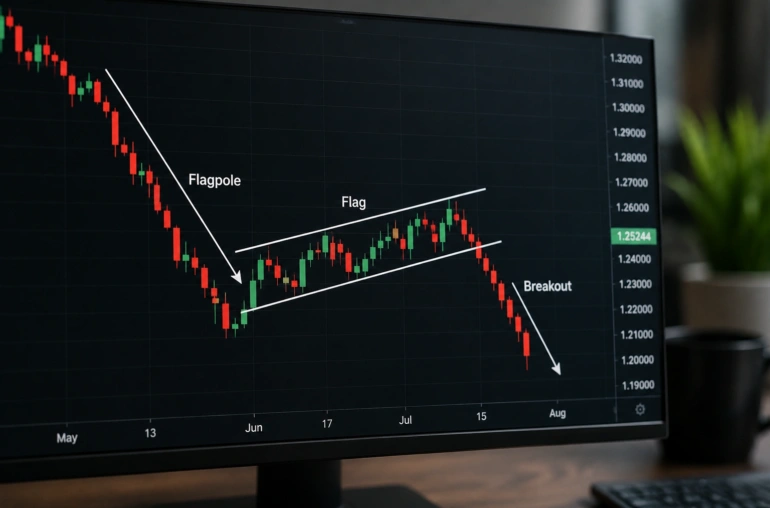
Breakout trading is one of the widely studied approaches among short-term traders. It involves watching an asset approach an important price level, such as resistance, support, a previous high, or a previous low. A trader may look for the price to move beyond that level with sufficient participation. Volume, candle structure, and the broader market environment can provide additional context when evaluating whether a breakout appears meaningful. For more: What Is Scalping in Trading? A Beginner’s Guide
Not every breakout continues. A price can move beyond resistance briefly before returning below it, creating what traders often call a false breakout. For this reason, experienced traders generally avoid treating a single price movement as automatic confirmation. A beginner studying this approach can review historical charts and examine what happened after different breakout setups. Keeping records of successful and unsuccessful examples can help reveal when the strategy performs better and when market conditions make it less reliable.
Scalping Strategy
Scalping is a very short-term trading approach in which traders attempt to capture relatively small price movements through multiple trades. Positions may remain open for only seconds or minutes, depending on the market and the trader’s method. Because individual price targets can be small, execution speed, transaction costs, spreads, and liquidity become particularly important. A strategy that looks profitable before costs may produce a very different result after all expenses are considered.
Scalping also demands significant concentration. A trader may need to monitor price action continuously and make rapid decisions throughout a session. This can make the approach challenging for inexperienced traders. Someone considering scalping should first understand order types, market liquidity, execution risk, and position sizing. Practicing with simulated trades can help a new trader become familiar with the pace without immediately exposing substantial capital to short-term market fluctuations.
Range Trading Strategy
Range trading focuses on markets that repeatedly move between recognizable support and resistance areas rather than following a strong directional trend. A trader may observe an asset approaching the lower part of its established range and look for evidence that buyers are becoming active. Similarly, movement toward the upper boundary may attract attention from traders looking for potential resistance.
The main challenge is knowing when the range has ended. Markets can remain sideways for a period and then suddenly break into a new trend. A trader who continues applying range-based rules after a genuine breakout may enter positions that no longer fit the original setup. This is why market context matters. Before using range trading, traders should examine the width and duration of the range, volume behavior, broader market direction, and whether price is repeatedly respecting the same levels.
Reversal Trading Strategy
Reversal trading attempts to identify situations where an existing price movement may be losing strength and preparing to move in the opposite direction. Traders may study support and resistance, momentum indicators, candlestick behavior, volume, or divergences to find potential reversal signals. Unlike momentum trading, which generally follows an established move, reversal trading attempts to participate closer to a possible turning point.
The major risk is entering too early. A price that appears overextended can continue moving in the same direction for much longer than expected. For example, a stock that has risen sharply may look expensive based on a trader’s assumptions, but that does not mean it must immediately fall. Reversal traders therefore need confirmation and clearly defined risk levels. Patience is particularly important because identifying a potential turning point is different from proving that a reversal has actually started.
Moving Average and Trend Strategies
Moving averages are commonly used to help traders identify the general direction of price movement. A trader might compare the current price with a moving average or observe how shorter-term and longer-term averages interact. These tools can help filter market noise and provide a framework for studying trends, but they should not be treated as guaranteed prediction systems.
Trend-following approaches generally work best when a market is making relatively clear directional moves. During sideways or highly choppy conditions, repeated signals can lead to unnecessary trades. A practical approach is to combine moving-average information with price structure, volume, and support or resistance. Traders who want to understand technical analysis in greater depth can also study related topics such as [moving average indicators], [support and resistance], and [candlestick chart patterns] to build a stronger analytical foundation.
Risk Management for Day Trading
Risk management is the foundation beneath almost every successful trading plan. Even a strategy with a historical advantage can experience losing trades, so traders need to decide how much capital they are willing to put at risk before entering a position. Position sizing should take the entry price, potential exit point, account size, and acceptable loss into consideration. This prevents a single trade from having an unnecessarily large impact on the overall account.
A stop-loss can help define when a trade idea is no longer working, although actual execution can differ from the intended price during fast-moving or illiquid conditions. Traders should also consider commissions, spreads, slippage, and other trading costs. Leverage deserves particular caution because it can increase exposure and magnify losses as well as gains. A disciplined trader does not need to predict every market move. Instead, the focus is on controlling the amount that can be lost when an idea proves incorrect.
How to Choose the Right Strategy
The best day trading strategies are not necessarily the most complicated ones. A suitable strategy should fit the trader’s available time, experience, financial resources, preferred markets, and ability to handle rapid decisions. Someone who cannot continuously watch a market may struggle with a highly active scalping approach. Another trader may prefer a slower setup based on breakouts or established trends.
Testing a strategy is also important before committing meaningful capital. Traders can study historical charts, use paper trading, and maintain a detailed journal showing entries, exits, market conditions, and outcomes. The objective is not simply to count winning trades. A useful review should examine average gains, average losses, losing streaks, trading costs, and whether the rules were followed. This process can help determine whether a strategy has a consistent structure rather than relying on a few memorable winning trades.
Common Mistakes When Using Trading Strategies
One major mistake is changing strategies after every losing trade. No legitimate trading method wins every time, so abandoning a system after a small sample can prevent a trader from learning how it actually behaves. Another problem is combining too many indicators or rules until the strategy becomes difficult to understand. More information does not necessarily produce better decisions, particularly when several indicators provide conflicting signals.
Emotional trading is another common challenge. After losing money, a trader may increase position size to recover quickly. After making a large gain, they may become overconfident and take trades outside their normal rules. Both behaviors can damage a carefully designed process. A trading journal can help identify these patterns. Recording not only what happened in the market but also why a decision was made provides valuable information that can be used to improve discipline and future execution.
How to Build a Day Trading Plan
A trading plan turns a general strategy into a practical set of rules. Instead of simply saying that you trade breakouts, for example, the plan should define what qualifies as a breakout, which markets are suitable, what confirmation is required, where the trade becomes invalid, and how much risk is acceptable. Clear rules reduce the temptation to improvise when prices begin moving quickly.
A useful plan can include:
- The markets and trading sessions you will focus on.
- Specific entry and exit conditions.
- Maximum risk allowed per trade and per session.
- Conditions that make you stop trading.
- A process for reviewing completed trades.
- Rules for avoiding impulsive or revenge trades.
The plan should remain simple enough to follow consistently. After collecting sufficient practice data, traders can make measured adjustments rather than constantly changing their rules. This creates a feedback loop in which research, execution, review, and improvement become part of the same process.
Frequently Asked Questions
What are the best day trading strategies for beginners?
Beginners can study straightforward approaches such as trend following, breakouts, and range trading. The most appropriate method depends on the trader’s experience, risk tolerance, schedule, and market.
Which day trading strategy is most profitable?
There is no strategy that is consistently the most profitable for every trader or market. Results depend on execution, market conditions, risk management, costs, and the trader’s ability to follow defined rules.
Can day trading strategies be tested before using real money?
Yes. Traders can review historical price data and use paper-trading or simulated accounts to practice. Testing can help identify weaknesses before significant capital is exposed.
How many day trading strategies should I learn?
Beginners may benefit from focusing on one or two strategies initially. Understanding a small number of setups deeply is generally more useful than collecting many strategies without learning how to execute them properly.
Do technical indicators guarantee successful trades?
No. Indicators are analytical tools, not guarantees. They can provide information about price, momentum, trends, or volume, but markets remain uncertain and unexpected movements can occur.
Conclusion
Understanding day trading strategies is about developing a repeatable process rather than searching for a perfect market signal. Momentum, breakout, scalping, range, reversal, and trend-based approaches each respond to different market conditions. The right choice depends on the trader’s goals, experience, available time, and tolerance for risk.
Before trading with meaningful capital, take time to study one strategy, test its rules, practice execution, and track the results in a trading journal. Combine your strategy with sensible risk management and disciplined decision-making. If you want to build stronger market knowledge, continue exploring related resources on technical analysis, trading psychology, and risk management before taking the next step.