Paper trading allows people to practice buying and selling financial assets without using real money. Instead of placing actual trades, traders use a simulated account to test their ideas. The account usually provides virtual funds and tracks hypothetical profits and losses. This makes paper trading useful for beginners who want to understand how markets work before taking financial risks. Experienced traders can also use it to test new strategies or become familiar with a different market. While simulated trading can teach valuable skills, it does not perfectly reproduce the emotions and conditions of real trading. Understanding both its advantages and limitations can help you use this practice more effectively.
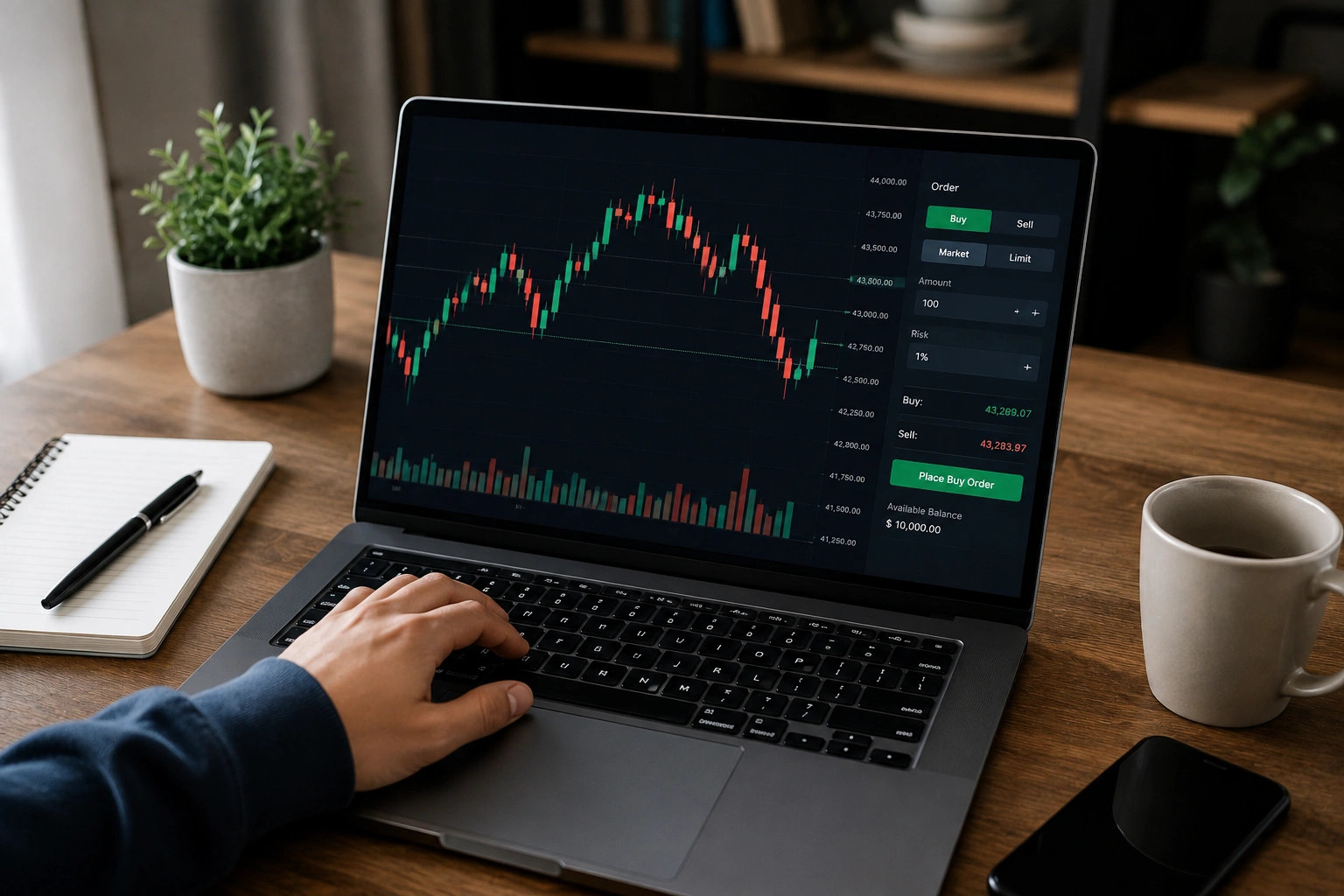
Paper trading can cover many markets, including stocks, forex, futures, options, and cryptocurrencies. Most modern trading platforms offer some form of simulated trading environment. The exact features vary between platforms, so traders should understand how orders, fees, spreads, and execution work within their chosen system. A beginner might use a virtual $10,000 account to practice buying shares and managing positions. Instead of losing real money, the trader can observe what would have happened to each position. This creates an opportunity to learn from mistakes without immediately putting capital at risk. However, traders should treat simulated results as practice rather than proof of future performance.
What Is Paper Trading?
Paper trading is a form of simulated trading that lets investors practice market transactions without using real capital. The name comes from the traditional practice of writing down hypothetical trades on paper. Today, traders usually use online platforms that automatically track virtual positions. A simulated account can show an entry price, exit price, profit or loss, and account balance. Some platforms also provide charts, technical indicators, and different order types. This makes the experience closer to actual trading than simply writing hypothetical prices in a notebook. However, the exact experience depends on the platform and its simulation features.
The main purpose of paper trading is practice. A new trader can learn how to place orders, read charts, manage positions, and follow a trading plan. For example, someone interested in stock trading might choose five companies and create hypothetical positions. They can then monitor those trades for several weeks. This process can reveal whether their strategy makes sense before they commit real money. Traders can also explore related subjects such as technical analysis, risk management, and position sizing while practicing. These skills are important because successful trading involves much more than identifying whether a market might rise or fall.
How Does Paper Trading Work?
A paper trading account normally starts with a balance of virtual money. The trader can use that balance to place simulated buy and sell orders. Depending on the platform, the account may support market orders, limit orders, stop orders, and other trading functions. When an order executes, the platform records the position and updates the virtual account balance. The trader can then monitor the position just as they would monitor a real trade. Some platforms use live market prices, while others may use delayed data. Understanding this difference can help traders interpret their results correctly.
Imagine that a beginner receives $50,000 in virtual funds. They decide to practice a simple stock strategy. The trader buys shares after a technical breakout and sets a simulated stop-loss below a recent support level. If the price rises, the platform records a hypothetical gain. If the price falls, it records a hypothetical loss. The trader can repeat this process over dozens of trades. Afterward, they can review the results and identify patterns. This approach provides more useful information than judging a strategy from one or two successful trades. A larger sample can reveal weaknesses that may otherwise remain hidden.
Benefits of Paper Trading
One of the biggest benefits of paper trading is reduced financial risk. Beginners can make mistakes without losing their savings. This creates a safer environment for learning basic trading mechanics. A new trader can practice entering and exiting positions, setting stop-loss orders, and calculating potential risk. The process can also reduce confusion when the trader eventually uses a live platform. Familiarity with the interface can make actual order placement easier. However, traders should remember that simulated practice cannot remove all of the challenges involved in real markets.
Paper trading can also help traders test a strategy before committing real capital. Suppose a trader develops a strategy based on moving averages and support levels. Instead of immediately using real money, they can test the rules across many historical or live market situations. They can record the number of winning trades, losing trades, average gain, and average loss. This information can help them decide whether the strategy deserves further testing. Traders can also use a trading journal to document their decisions. Keeping detailed records can make the learning process more objective and easier to evaluate.
Paper Trading for Beginners
Beginners can use paper trading to learn the basic language of financial markets. Terms such as bid, ask, spread, market order, limit order, stop-loss, and position size can seem confusing at first. A simulated account gives new traders an opportunity to see how these concepts work in practice. They can place different types of orders and observe how those orders behave. This hands-on experience can be more useful than simply reading definitions. Beginners should start with a simple strategy instead of trying to learn every indicator at once. For more: Will Crypto Go Back Up? What Investors Should Know
A beginner might start by following one market and one basic setup. For example, they could practice identifying support and resistance on a stock chart. They could then create a simulated trade when price reaches a predefined level. The trader should record the reason for entering, the planned stop, and the target. After the trade closes, they can review what happened. This process teaches discipline and encourages traders to follow rules. Beginners can also study risk-reward ratios and position sizing while practicing. These concepts become easier to understand when applied to actual chart examples.
Paper Trading vs Real Trading
Paper trading and live trading share many similarities, but they are not identical. Both can involve charts, orders, market prices, technical indicators, and trading plans. The biggest difference is financial and emotional risk. A simulated loss does not reduce a trader’s bank balance. A real loss does. This difference can significantly change decision-making. A trader may calmly accept a $500 simulated loss but struggle with the same loss when real money is involved. Emotional pressure can influence entry decisions, stop-loss placement, and trade management.
Execution can also differ between simulated and live environments. Real trades may experience slippage, spreads, commissions, liquidity limitations, and order delays. Some paper trading systems may not reproduce these conditions accurately. A strategy that looks excellent in simulation could perform differently with real execution costs. For this reason, traders should not assume that a high simulated return guarantees similar live results. Paper trading works best as one stage of a broader learning process. After sufficient practice, traders may choose to move gradually toward live trading with appropriately small risk rather than making a sudden transition.
How to Start Paper Trading
Starting a paper trading account is usually straightforward. First, choose a platform that provides a simulated trading feature for the market you want to study. Check whether it offers real-time or delayed market data and whether it includes the order types you plan to use. Then create a virtual balance that resembles the amount you might realistically invest. Giving yourself an unrealistically large account can produce misleading results. For example, practicing with $1 million when you plan to invest $5,000 may encourage excessive position sizes.
Once the account is ready, create a simple trading plan. Define the market, entry conditions, stop-loss, target, position size, and exit rules before placing each simulated trade. Then record every trade in your journal. Review the results after a meaningful number of trades rather than changing your strategy after every loss. A basic process can include:
- Choose a suitable simulated trading platform.
- Set a realistic virtual account size.
- Select a simple strategy.
- Define entry and exit rules.
- Record every simulated trade.
- Review performance regularly.
This structured approach can turn paper trading into a useful learning exercise instead of casual market guessing.
Common Paper Trading Mistakes
One common mistake is treating simulated money like unlimited money. Some beginners take extremely large positions because they know they cannot lose real capital. This behavior creates unrealistic results. If the same strategy would be too risky with real money, it should not form the basis of a serious trading plan. Traders should use realistic position sizes and risk limits during simulation. This makes the transition to live trading more meaningful. Another mistake involves changing strategies too frequently. A trader may abandon a strategy after three losing trades without giving it enough time for proper evaluation.
Another problem is ignoring trading costs and execution quality. A simulated platform may not always reproduce real spreads, commissions, or slippage. Traders should account for these factors whenever possible. Emotional behavior also remains difficult to simulate. A trader can feel confident after a string of virtual wins and then become nervous when real money is involved. This limitation means paper trading cannot fully prepare someone for the psychological side of live markets. A good trading journal can still help by recording emotions, decisions, and mistakes. Reviewing those records can reveal habits that may affect future performance.
How Long Should You Paper Trade?
There is no universal amount of time that every trader should spend paper trading. The right period depends on experience, strategy complexity, market knowledge, and consistency. A beginner may need several weeks or months to become comfortable with basic order types and risk management. Someone with years of experience may use simulation for a shorter period when testing a new strategy. The number of trades can also matter more than the calendar period. A strategy tested across a meaningful sample can provide more information than a few trades completed over several months.
The goal should not be to achieve a certain virtual profit before going live. Instead, traders should focus on consistency and rule-following. They should understand why each trade was taken and whether the strategy produced reasonable results across different market conditions. Once a trader has enough evidence, they can consider moving to a small live account if appropriate. Starting with limited risk can make the emotional transition easier. Traders should continue tracking performance after going live because real execution and psychology may change the results. This approach creates a more realistic bridge between practice and actual trading.
Does Paper Trading Really Work?
Paper trading can work well as a learning and testing tool, especially for beginners. It provides an environment where traders can practice market analysis and order placement without putting real capital at risk. It can also help experienced traders test new ideas before using them in live markets. The greatest value comes from treating the process seriously. Traders should follow realistic rules, use sensible position sizes, and record their results. Casual simulated trading may provide entertainment, but structured practice can provide much more useful information.
However, paper trading cannot reproduce every aspect of live trading. The emotional impact of real financial losses remains difficult to simulate. Execution can also differ because of liquidity, slippage, spreads, and commissions. These differences mean that simulated success should not create excessive confidence. A trader who makes consistent profits in a simulated environment still needs to adapt when real money is involved. Combining paper trading, market education, risk management, and gradual live experience can create a more balanced learning process. The goal is not to prove that you can always win, but to develop a repeatable and disciplined approach.
FAQ
What is paper trading?
Paper trading is simulated trading with virtual money. It allows people to practice buying and selling assets without risking real capital.
Is paper trading free?
Many platforms offer free paper trading, but features and market data can vary. Always check the platform’s current terms.
Can beginners use paper trading?
Yes. It is especially useful for beginners who want to learn trading basics, test strategies, and practice order placement.
Is paper trading the same as real trading?
No. It can simulate trading mechanics, but it cannot fully reproduce real emotions, slippage, fees, and execution conditions.
How long should I paper trade?
There is no fixed period. Continue until you understand your strategy and have enough trades to evaluate its performance realistically.
Conclusion
Paper trading provides a practical way to learn trading without immediately risking real money. It can help beginners understand orders, charts, position sizing, and risk management. Experienced traders can also use it to test new strategies and trading ideas. The most effective approach involves realistic account sizes, clear rules, detailed records, and consistent review.
However, simulated results do not guarantee live performance. Real money introduces emotional pressure, execution differences, trading costs, and other challenges. For that reason, traders should treat paper trading as preparation rather than a final test of success. If you are learning to trade, start with a simple strategy, keep a detailed trading journal, and focus on building disciplined habits before considering real-money positions.