The most volatile stocks can experience unusually large price movements within a single trading session. These shares attract active traders because substantial moves can create opportunities for both gains and losses. Volatility, however, does not tell you whether a company is good or bad. It simply describes how dramatically its price can change over time.
A volatile stock may react strongly to earnings, breaking news, analyst changes, economic data, or shifts in investor sentiment. Smaller companies can also experience extreme moves when trading volume is limited. The SEC’s Investor.gov explains that volatility refers to price fluctuations and warns that short-term trading in volatile markets can result in significant losses.
What Are the Most Volatile Stocks?
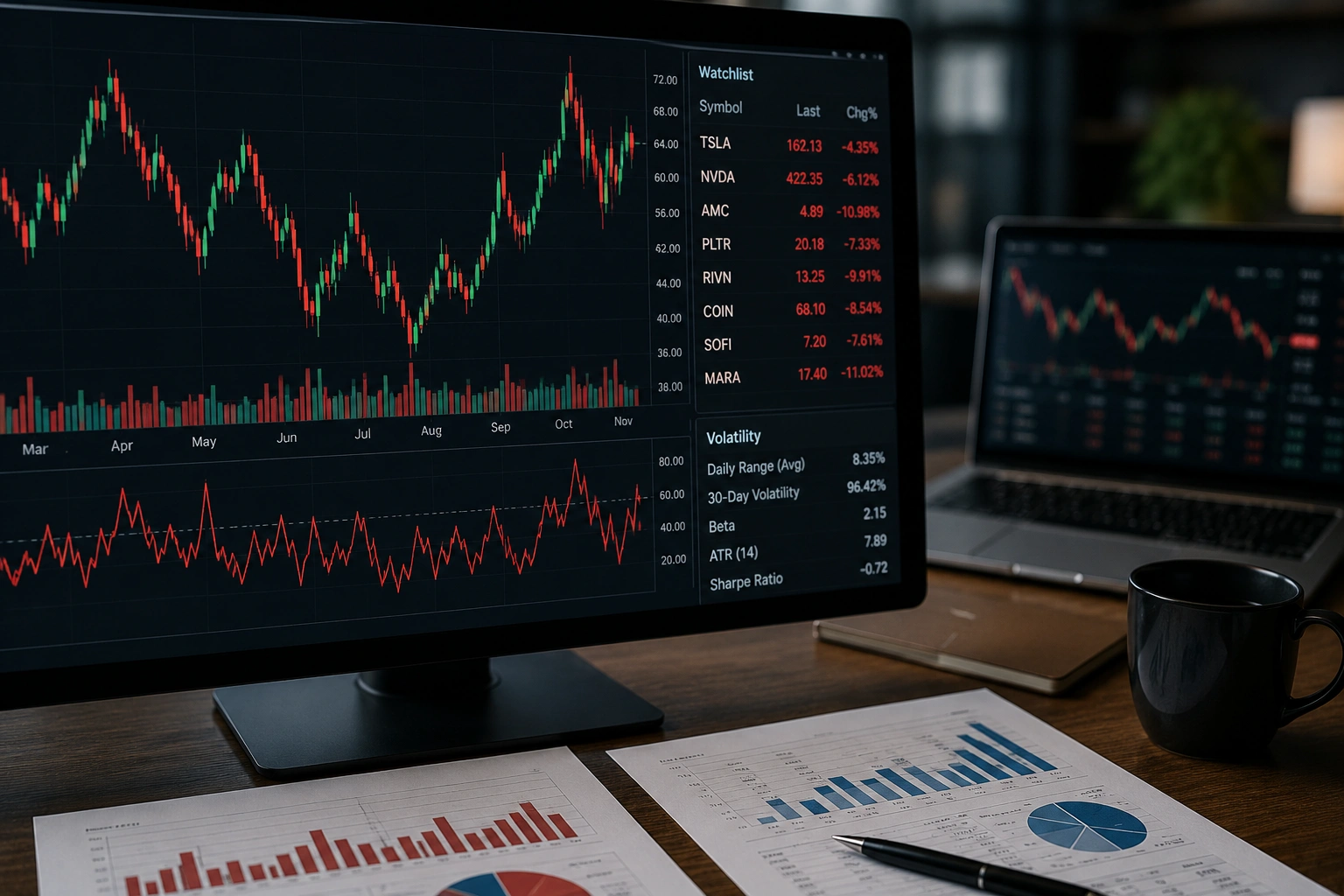
The most volatile stocks are shares that show larger-than-usual price movements compared with other stocks or with their own historical trading patterns. Investors often identify them using measures such as historical volatility, beta, average true range, or daily percentage changes. Each measurement captures a slightly different aspect of price movement.
A stock can become highly volatile for many reasons. A small biotechnology company may move sharply after clinical-trial news. A technology company can react strongly to earnings or changes in growth expectations. A heavily shorted stock may also experience rapid moves when traders rush to cover positions. Investor.gov notes that stock prices can respond to company-specific events as well as broader political and market developments.
Why Do Some Stocks Become Highly Volatile?
Company news is one of the biggest sources of volatility. Earnings announcements, mergers, product launches, regulatory decisions, lawsuits, and management changes can quickly alter investor expectations. When new information differs significantly from what the market expected, buyers and sellers may adjust their positions rapidly.
Market conditions can create another layer of volatility. Interest-rate decisions, inflation data, employment reports, geopolitical developments, and large market moves can affect entire sectors. A recent Reuters report highlighted how changing views around artificial intelligence, interest rates, and market leadership have contributed to unusual movements across technology-related markets.
How to Measure Stock Volatility
Investors use several metrics to determine how much a stock tends to move. Beta compares a stock’s historical sensitivity with a broader market benchmark. A beta above 1 generally indicates greater historical movement than the benchmark, while a beta below 1 suggests less sensitivity. However, beta does not predict exactly how a stock will behave tomorrow.
Another useful measurement is average true range (ATR). ATR focuses on the size of a stock’s trading range and can help traders understand typical daily movement. Some market screeners rank stocks using volatility and intraday range, making it easier to identify shares that regularly experience large price swings.
Most Volatile Stocks and Trading Volume
Trading volume is extremely important when evaluating volatile shares. A stock with heavy volume can absorb large numbers of buy and sell orders more easily than a thinly traded stock. This difference can affect how quickly investors enter or exit positions and how much their orders influence the market price. For more: Jerome Powell Net Worth: Wealth, Salary & Career
Low liquidity can make volatility particularly dangerous. Investor.gov explains that less-liquid stocks may become harder to sell without significantly affecting their price. This issue can become more serious with small-cap and microcap stocks, which historically tend to experience both lower liquidity and higher volatility.
Most Volatile Stocks by Market Capitalization
Market capitalization can help explain why some stocks move more dramatically than others. Large-cap companies usually have more shareholders, deeper markets, and greater trading liquidity. Their prices can still move sharply, especially after major earnings announcements, but their average fluctuations may differ from those of smaller companies.
Small-cap and microcap stocks can produce much larger percentage changes. A relatively small amount of buying or selling can have a substantial impact when fewer shares trade regularly. Investor.gov specifically warns that microcap stocks can experience sudden price changes and limited liquidity. Investors researching most volatile stocks should therefore consider market capitalization alongside volatility metrics.
Sectors That Often Experience High Volatility
Some sectors naturally attract greater price fluctuations because their valuations depend heavily on future expectations. Biotechnology is one example. A clinical-trial result can dramatically change expectations about a company’s future revenue. Semiconductor and artificial-intelligence companies can also experience large moves when investors reassess growth forecasts or technology demand.
Energy and commodity-related companies can behave differently. Their share prices may respond to changes in oil, natural gas, metals, or other underlying commodity prices. Financial stocks can become volatile during periods of changing interest rates or concerns about credit quality. The important point is that volatility varies by company, sector, market conditions, and time period rather than following one permanent pattern.
Most Volatile Stocks and Earnings Season
Earnings season can create some of the year’s biggest individual stock movements. Investors receive fresh information about revenue, profits, margins, cash flow, guidance, and future demand. A company can report strong results and still fall if investors expected an even better performance.
Options markets can amplify attention around earnings. Traders often monitor implied volatility before major announcements because the market expects potentially significant price movement. Investors should remember that expected volatility does not indicate the direction of the move. A stock can make a large move upward or downward after the same earnings announcement.
How News Affects Highly Volatile Stocks
News-driven volatility can appear within minutes. A regulatory approval, takeover announcement, unexpected earnings result, analyst downgrade, or major corporate development can rapidly change the balance between buyers and sellers. Social-media attention can also increase trading activity, particularly among smaller companies.
The SEC has warned investors about relying on social-media hype when trading volatile stocks. Its Investor Alert explains that short-term trading can carry significant risks and that following market excitement can result in substantial losses. A sensible approach is to verify the original news source before reacting to a dramatic price move.
How to Find the Most Volatile Stocks
Investors can use stock screeners to locate shares with unusually large price movements. A useful screener can combine volatility with liquidity, market capitalization, price, and trading volume. This approach can eliminate some extremely thinly traded securities and create a more practical watchlist.
A simple research process can include:
- Start with daily volatility or ATR.
- Check average and relative trading volume.
- Review market capitalization and share price.
- Look for recent earnings or company news.
- Compare the stock with other companies in its sector.
- Review historical price movements before taking action.
MarketBeat and other screeners provide volatility rankings and filters that allow investors to examine stocks across different market-cap categories and sectors.
Most Volatile Stocks vs. High-Growth Stocks
Volatility and growth are not the same thing. A company can have excellent revenue growth and relatively stable trading. Another company can have limited revenue, uncertain prospects, and extremely high volatility. Investors should avoid assuming that a highly volatile stock automatically offers greater growth potential.
The distinction matters because volatility measures price behavior, not business quality. Investor.gov describes risk as uncertainty surrounding investment returns and potential financial loss. Investors should therefore examine fundamentals separately from volatility. Revenue growth, profitability, debt, cash flow, valuation, and competitive advantages can provide a better picture of the underlying business.
Risks of Investing in Highly Volatile Stocks
The primary risk is that losses can accumulate quickly. A stock that falls 20% needs a 25% gain to return to its previous price. Larger declines require even stronger recoveries. Rapid price movement can also make emotional decision-making more likely, especially when investors watch every intraday move.
Leverage can increase these risks substantially. Margin and options can magnify both gains and losses, while short selling creates its own risk profile. The SEC specifically warns that short-term trading, margin, and certain options strategies can lead to significant and unexpected losses. Investors should understand these risks before using volatile stocks for short-term strategies.
Are the Most Volatile Stocks Good for Beginners?
Highly volatile shares are usually challenging for inexperienced investors because price movements can be difficult to manage emotionally. A beginner may see a stock rise quickly and chase it, only to experience a sharp reversal shortly afterward. The same problem can occur after a sudden decline when fear encourages an investor to sell without understanding the underlying catalyst.
Diversification can help reduce the impact of any single stock. Investor.gov explains that asset allocation should reflect an investor’s time horizon and risk tolerance. Beginners may therefore benefit from learning how volatility works before allocating a significant portion of their portfolio to highly speculative shares.
How to Manage Risk With Volatile Stocks
Risk management starts with position size. Putting a smaller percentage of a portfolio into a highly volatile stock can limit the financial impact of an unexpected move. Investors should also understand the company’s fundamentals and the specific event driving volatility before entering a position.
It can also help to establish a clear investment thesis. Know why you are buying, what information could change your view, and how much risk you can realistically tolerate. Avoid relying solely on a stock’s recent price movement. A disciplined process can reduce the temptation to chase sudden rallies or panic during rapid declines.
Most Volatile Stocks and Long-Term Investing
Volatility does not automatically make a stock unsuitable for long-term investors. Some successful businesses experience substantial short-term price movements while continuing to grow over many years. The key question is whether the investor can tolerate those fluctuations without abandoning a sound long-term strategy.
Time horizon matters because short-term price movements can become less important when an investment is held for many years. Still, long-term investors should not ignore volatility completely. A severe decline can reflect genuine deterioration in a company’s business. Reviewing earnings, cash flow, debt, competition, and valuation remains essential.
FAQ
What are the most volatile stocks?
They are stocks that experience relatively large price movements over short periods. Investors commonly measure volatility using beta, historical volatility, ATR, trading range, and daily percentage changes.
Why are some stocks more volatile than others?
Company news, earnings, market sentiment, liquidity, market capitalization, short interest, and broader economic events can all influence volatility. Small companies often experience larger percentage movements than established large-cap businesses.
Are volatile stocks risky?
Yes. Greater price volatility can create larger potential gains but also larger potential losses. Investor.gov emphasizes that market volatility can produce significant financial risk.
How can I find volatile stocks?
Use a stock screener that ranks securities by volatility, ATR, beta, or daily price movement. Adding filters for trading volume and market capitalization can make the results more useful.
Should beginners trade highly volatile stocks?
Beginners should approach them carefully. Understanding position sizing, liquidity, valuation, and risk management is important before trading stocks with unusually large price swings.
Conclusion
The most volatile stocks can offer significant trading opportunities, but they also carry considerable risk. Large price movements can result from earnings, breaking news, market sentiment, low liquidity, economic developments, or company-specific events. Volatility measurements such as beta and ATR can help investors identify these stocks, but those metrics do not determine whether a company represents a good investment.
A stronger approach combines volatility analysis with fundamental research, trading volume, valuation, and appropriate risk management. Investors should also consider their time horizon and ability to tolerate losses. Before adding a highly volatile stock to a portfolio or watchlist, research the underlying business and understand what is driving its price movement.