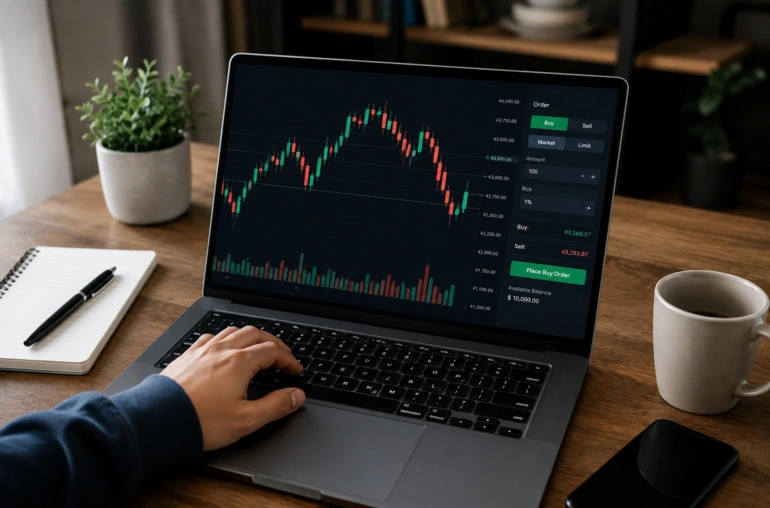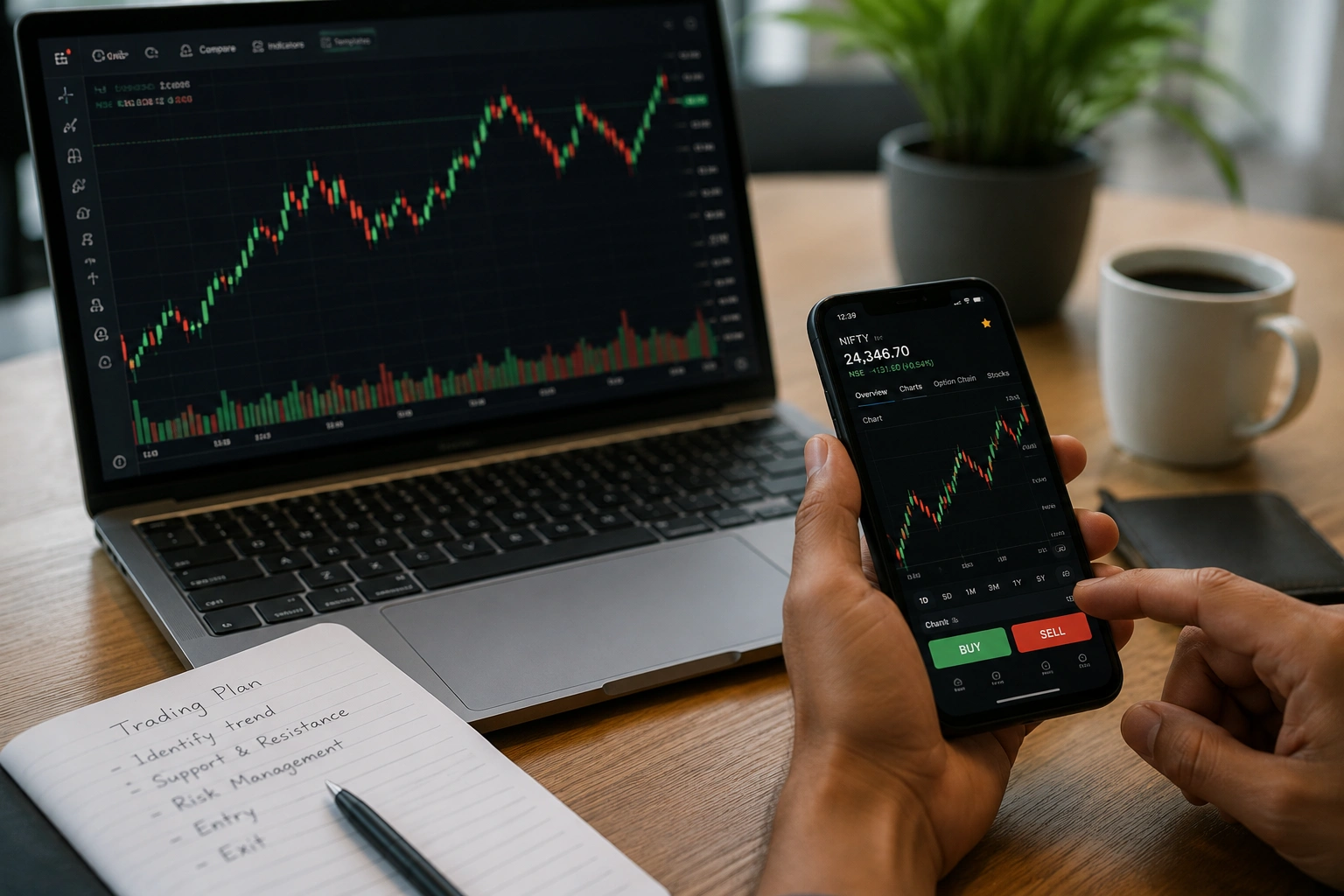
Learning how to day trade means understanding how traders buy and sell financial assets within the same trading day, usually attempting to benefit from short-term price movements. Unlike long-term investing, day trading focuses on shorter time frames and requires careful planning, fast decision-making, and strict risk control. Traders may work with stocks, exchange-traded funds, currencies, futures, or other financial instruments, depending on their market access and local regulations. While day trading can look simple from the outside, consistently making profitable trades is difficult, and losses can happen quickly. Beginners should therefore focus first on education, practice, position sizing, and protecting their trading capital rather than trying to make fast money.
What Is Day Trading?
Day trading is a trading approach where positions are generally opened and closed during the same trading session. A day trader may buy an asset and sell it later that day, or sell first and buy it back later when the market permits. The objective is to benefit from relatively small price changes rather than holding an investment for months or years. Because positions are usually closed before the end of the session, day traders generally avoid the overnight price risk associated with holding positions after the market closes.
The basic idea sounds straightforward, but successful execution requires considerably more than identifying whether a price might rise or fall. A trader needs to understand market liquidity, volatility, order types, transaction costs, and risk. For example, a stock may appear attractive because it is moving quickly, but a wide bid-ask spread can make entering and exiting expensive. Anyone learning how to day trade for beginners should therefore learn market mechanics before risking real money and should treat trading as a high-risk skill that requires preparation rather than as a shortcut to income.
Choose a Market to Trade
The first practical decision is choosing the financial market that fits your knowledge, available capital, schedule, and risk tolerance. Stocks are popular because they are widely followed and provide access to many publicly traded companies. ETFs can offer exposure to groups of assets, while foreign exchange markets operate across global trading sessions. Futures provide access to various markets but can involve substantial leverage and therefore require particularly careful risk management.
Beginners should avoid trying to trade everything at once. Each market has different trading hours, costs, liquidity patterns, and rules. A person who understands company earnings and stock-market news may find equities easier to study than currencies, while someone interested in macroeconomic events may prefer learning about foreign exchange. Before opening trades, study the market’s trading hours, minimum price movements, commissions, spreads, margin requirements, and applicable regulations. This foundational knowledge can also support related learning about stock market basics, technical analysis, and investment risk management.
Learn How Price Movements Work
Understanding price movement is central to learning how to day trade. Prices change because buyers and sellers continuously interact, with supply and demand influencing the prices at which transactions occur. News, earnings reports, economic data, interest-rate expectations, market sentiment, and unexpected events can all affect this balance. A stock can move sharply after an earnings announcement, for example, because traders revise their expectations about the company’s future performance.
Day traders commonly study price charts to identify trends, ranges, breakouts, reversals, and areas where buying or selling activity has previously increased. Technical indicators such as moving averages, volume measures, and relative strength indicators may be used as supporting tools. However, no indicator can reliably predict every future movement. Beginners should avoid filling charts with dozens of indicators. A simpler approach is usually easier to understand and test. Studying technical analysis for beginners can help explain why traders use price, volume, support, resistance, and market structure when making short-term decisions.
Create a Simple Day Trading Strategy
A day trading strategy is a defined set of conditions that determines when you consider entering, managing, and exiting a trade. Without clear rules, beginners can easily make decisions based on fear, excitement, or the desire to recover a previous loss. A basic strategy might focus on a trend continuation, a range breakout, or a reversal near an important price level. The specific strategy matters less at first than having rules that can be clearly explained and tested. For more: Utility Stocks: A Simple Guide for Investors
A useful strategy should answer several basic questions before a trade is placed. What market condition are you looking for? What confirms the entry? Where will the trade be considered wrong? How much money can be lost if the idea fails? When will profits be taken? These questions turn an idea into a repeatable process. Traders can then review historical charts or use simulated trading to evaluate whether the strategy behaves as expected. This process is often called backtesting, although historical performance should never be treated as a guarantee of future results.
Practice With a Trading Simulator
Paper trading or simulated trading allows beginners to practice without immediately risking real capital. A trading simulator can reproduce many parts of the trading process, including placing orders, managing positions, setting stops, and recording results. This can be especially useful for learning how a platform works before real money is involved.
However, simulated results have limitations. Emotional pressure is often much lower when losses are not real, so a strategy that looks easy in a simulator may feel very different when actual money is at risk. Market simulators can also differ from real trading because of execution delays, liquidity, slippage, or other factors. For these reasons, paper trading should be viewed as training rather than proof that someone is ready to trade profitably. Keeping a trading journal during practice can help identify repeated mistakes and reveal whether the trader is following the strategy consistently.
Risk Management Is More Important Than Profit Targets
Risk management is one of the most important parts of learning how to day trade. A trader can have a strategy that wins frequently and still lose substantial money if the losing trades are too large. For this reason, traders often determine their maximum acceptable loss before entering a position. Position size can then be adjusted according to the distance between the entry price and the planned stop level.
A practical risk-management framework may include predefined position sizes, maximum daily losses, and rules against repeatedly increasing trade size after losses. A stop-loss order can also be used to help control a position, although stop orders do not guarantee an exact execution price in fast-moving markets. Leverage deserves special attention because it allows traders to control larger positions with less capital but can magnify both gains and losses. Beginners should understand position sizing, stop-loss orders, and leverage risk before using borrowed funds.
Understand Trading Costs and Taxes
Trading costs can have a major effect on short-term results because day traders may place many transactions. Costs can include commissions, bid-ask spreads, exchange fees, financing charges, and slippage. Even when an individual trade appears profitable, repeated small costs can reduce overall returns. This is particularly important for strategies that target very small price movements.
Taxes can also affect the final outcome, and the rules differ significantly by country and type of trading activity. Some jurisdictions treat frequent trading differently from long-term investing, while others have specific rules for capital gains, business income, or financial transactions. Beginners should research the tax rules applicable to their location or speak with a qualified tax professional. When calculating strategy performance, use realistic assumptions about trading costs rather than focusing only on the chart price. Learning about capital gains taxes and trading fees can prevent unpleasant surprises after trading begins.
Build a Day Trading Routine
A consistent routine can help traders avoid impulsive decisions. Before the trading session begins, a trader can review major economic announcements, company news, market trends, and potential setups. The goal is not to predict everything that will happen but to identify situations that match the trading plan. During the session, the trader can monitor only selected markets and wait for predefined conditions instead of entering every time a price moves quickly.
After the session, reviewing trades can be just as important as placing them. A trading journal can record the setup, entry, exit, position size, reason for the trade, result, and whether the rules were followed. Over time, this information can reveal patterns that are difficult to notice from individual trades. For example, a trader might discover that losses occur mainly when trading during highly volatile news events. A structured day trading routine helps turn experience into information and can make it easier to improve without relying on memory or emotion.
Common Day Trading Strategies
There are several approaches traders use for short-term markets, and no single strategy works in every environment. Trend trading attempts to follow an established price direction, while breakout trading looks for prices moving beyond a defined range or important level. Range trading generally focuses on assets moving between areas of support and resistance. Some traders also use momentum strategies when an asset is experiencing unusually strong buying or selling activity.
Each approach has strengths and weaknesses. A trend strategy may struggle when the market moves sideways, while a range strategy can perform poorly during a powerful breakout. News-based trading can create large opportunities but also introduces rapid price movements and unpredictable execution. Beginners should focus on understanding one approach rather than jumping between strategies every time results are disappointing. Testing a method across different market conditions can provide a more realistic understanding of its behavior. This is one reason day trading strategies should be evaluated using defined rules and records rather than isolated winning trades.
The Psychology of Day Trading
Trading psychology can have a major influence on results because financial decisions involve real uncertainty and potential losses. Fear can cause a trader to exit a position too early, while greed can encourage excessive position sizes. After a loss, some traders may attempt to immediately recover the money by taking larger or lower-quality trades. This behavior is often called revenge trading and can turn a manageable loss into a much larger one.
Emotional control does not mean eliminating emotions completely. Instead, it means creating rules that reduce the influence emotions have on decisions. A trader might decide in advance how many trades to take, how much to risk, and when to stop for the day. Following those rules can be more valuable than trying to predict every market movement. Beginners should also understand that losing trades are an unavoidable part of short-term trading. The goal is not to win every trade but to manage risk and maintain a process that can be evaluated over a sufficiently large number of trades.
How Much Money Do You Need to Day Trade?
The amount of money required depends on the market, broker, account type, local regulations, and trading strategy. There is no universal minimum that guarantees a person can successfully day trade. Some markets can be accessed with relatively small amounts of capital, while others require considerably more because of margin requirements or contract sizes.
Having more capital does not automatically make day trading safer. A trader can lose a large account quickly by using excessive leverage or taking oversized positions. Conversely, an account that is too small for the chosen market may encourage the trader to take unnecessary risks simply to generate meaningful dollar returns. Beginners should focus on whether they can afford the potential losses rather than asking only how much they need to start. Money needed for rent, bills, emergency savings, education, or other essential expenses should not be treated as day trading capital.
Mistakes Beginners Should Avoid
Many new traders enter the market after seeing screenshots of large profits or hearing stories about people making money quickly. This can create unrealistic expectations and encourage excessive trading. One of the most common mistakes is entering positions without a defined exit plan. Another is risking too much on a single trade because the setup appears especially attractive. Markets can move against even highly convincing ideas, so confidence should never replace risk management.
Other mistakes include trading during major news events without understanding the risks, ignoring transaction costs, changing strategies after a few losing trades, and using leverage without fully understanding how it works. Beginners may also spend too much time searching for the “perfect” indicator instead of improving execution and discipline. A useful way to avoid these problems is to write trading rules before entering the market and review them regularly. Readers interested in common trading mistakes can use that knowledge to build a more realistic approach before committing significant capital.
How to Start Day Trading Step by Step
The safest way to approach day trading is to build knowledge and experience gradually rather than immediately placing large trades. A beginner can start by learning market terminology, choosing one market, studying basic price behavior, and creating a simple strategy. After that, simulated trading can provide an opportunity to practice the rules and identify weaknesses without putting real money at risk.
A basic starting process can include:
- Learn the basics: Understand orders, spreads, liquidity, margin, and market structure.
- Choose one market: Focus on a market you can study consistently.
- Create trading rules: Define entries, exits, position sizes, and maximum losses.
- Practice in simulation: Test the process before risking real capital.
- Keep a journal: Record every trade and review your decisions.
- Start cautiously: If you eventually use real money, keep position sizes appropriate to your risk tolerance.
- Review performance: Evaluate results over many trades instead of judging a strategy from one day.
This process does not guarantee profitability, but it can reduce avoidable mistakes and create a more disciplined learning environment. The objective should be skill development and capital preservation, not trying to make a certain amount of money every day.
Frequently Asked Questions
Can beginners learn how to day trade?
Yes. Beginners can learn the basics through education, simulated trading, and careful practice. Consistent profitability, however, is difficult and never guaranteed.
Is day trading profitable?
Some traders make profits, but many also experience losses. Results depend on strategy, execution, risk management, costs, market conditions, and discipline.
How many hours do day traders work?
It varies. Some traders focus on a few hours around the most active part of a market session, while others monitor markets for longer periods.
Is day trading better than investing?
Neither approach is automatically better. Day trading focuses on short-term price movements, while investing generally focuses on longer-term growth and ownership.
Can I day trade with a small amount of money?
It may be possible in some markets, but a small account can create pressure to take excessive risks. Account requirements and trading rules also vary by market and location.
Conclusion
Learning how to day trade is less about finding a secret strategy and more about developing a repeatable process. Beginners need to understand market mechanics, choose an appropriate market, create clear trading rules, practice before risking substantial capital, and manage losses carefully. Technical analysis can help identify potential setups, but no chart pattern or indicator can eliminate uncertainty.
The most important principle is to protect capital while learning. Day trading involves substantial financial risk, and past performance does not guarantee future results. If you are considering this approach, start by studying technical analysis, risk management, and paper trading, then build your knowledge gradually before deciding whether active trading is appropriate for you.