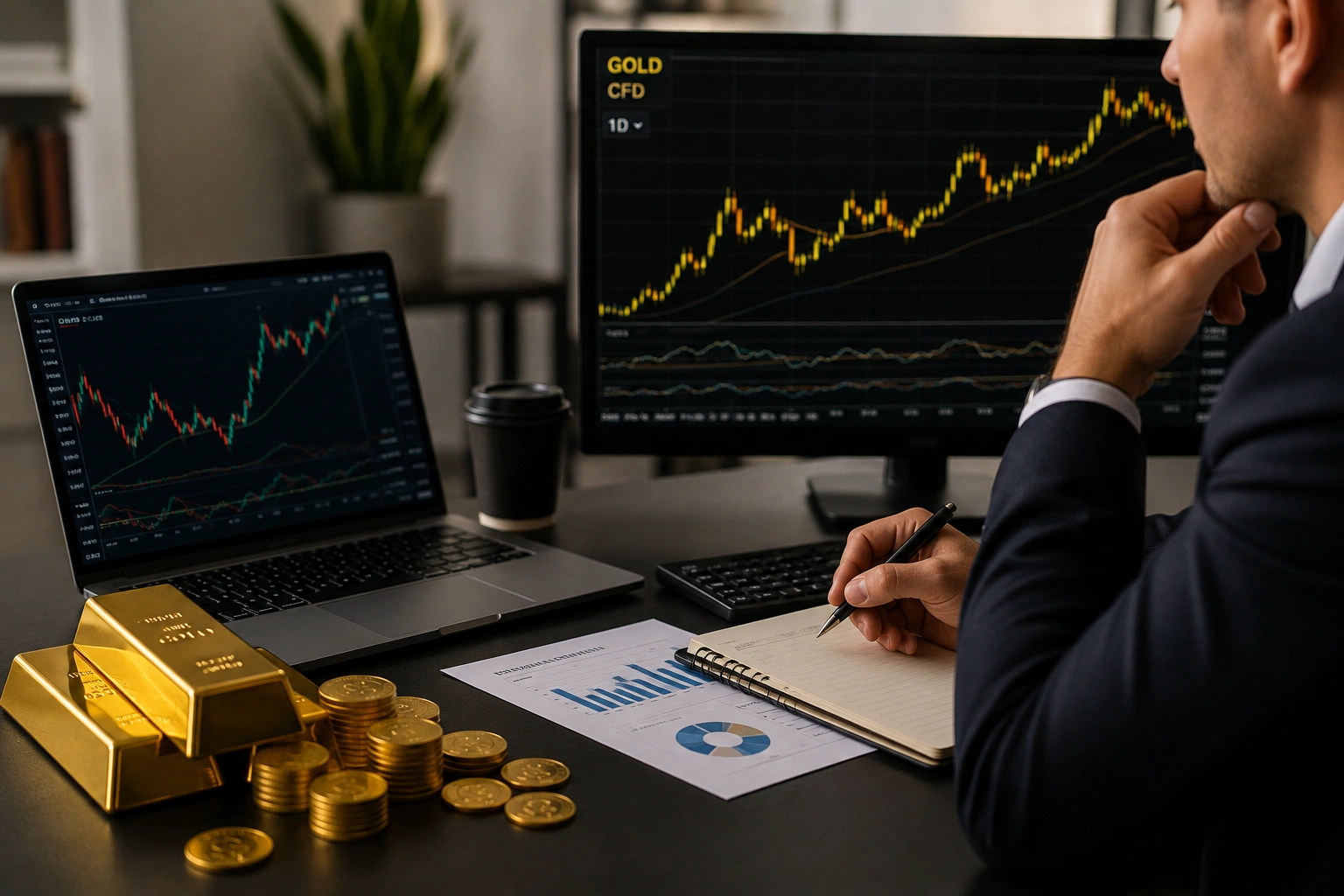
Learning how to trade gold can seem complicated at first, especially if you are new to financial markets. Gold is one of the world’s most widely followed commodities and is traded by investors, institutions, businesses, and individual traders. Its price can react to interest rates, inflation expectations, currency movements, economic data, geopolitical events, and changes in market sentiment. Today, traders can gain exposure to gold through several financial products, including spot gold, futures, exchange-traded products, and contracts for difference where legally available. However, gold trading also carries meaningful risk, particularly when leverage is involved. This guide explains how gold trading works, what moves the price, how beginners can build a simple trading plan, and why risk management is essential before putting real money into the market.
What Is Gold Trading?
Gold trading involves attempting to profit from changes in the market price of gold. Unlike buying a physical gold bar or jewelry for long-term ownership, financial gold trading usually involves a market instrument whose value follows the price of the underlying metal. Depending on the platform and country, traders may use spot gold, futures contracts, exchange-traded funds, or other regulated products.
The way you trade gold depends on the instrument available to you. For example, a futures contract has an expiration date and standardized contract specifications, while a spot gold product may be designed for shorter-term price exposure. Before deciding how to trade gold, beginners should understand exactly what they are buying or selling, what fees apply, and whether leverage is involved. Reading a beginner’s guide to commodity markets can provide useful background before moving into a live trading account.
How Gold Prices Move
Gold prices can respond to several economic and financial factors at the same time. Interest rates are particularly important because changes in rates can affect the attractiveness of holding non-interest-bearing gold compared with other assets. The U.S. dollar can also influence gold because internationally traded gold is commonly priced in dollars. A stronger or weaker dollar can therefore affect the price dynamics seen by global traders.
Market expectations matter as much as current economic conditions. Traders may react to inflation data, employment reports, central-bank decisions, economic growth figures, or geopolitical developments before the underlying event actually occurs. For someone learning how to trade gold, understanding these relationships is useful because gold does not move for just one reason. A strong trading plan considers both the broader economic environment and the price action visible on the chart.
Choosing a Gold Trading Market
Before placing a trade, decide which gold market fits your goals and circumstances. Some traders use gold futures because they are standardized and traded on regulated exchanges. Others use exchange-traded products that provide exposure to gold through a securities account. Spot gold and leveraged products may also be available through certain brokers, depending on local regulations. For more: Best Forex Broker: How to Choose the Right One
Each instrument has different costs, risks, contract specifications, and trading hours. For example, futures traders need to understand contract size, margin requirements, expiration, and settlement. Traders using leveraged products need to understand how financing charges and margin calls can affect their positions. If you are comparing ways of trading commodities, reviewing the differences between futures, ETFs, and leveraged products can help you choose an approach based on your actual needs rather than simply following another trader’s strategy.
How to Read a Gold Price Chart
A gold chart shows how the market price has changed over a selected period. Beginners can start with basic information such as price direction, support and resistance areas, trend structure, and trading volume where available. You do not need dozens of indicators to understand a chart. In many cases, a clean chart can make market conditions easier to interpret.
Timeframes are also important. A five-minute chart can show short-term price movements that may be irrelevant to someone planning to hold a position for several weeks. A daily or weekly chart can provide a broader view of the market trend. When learning how to trade gold, match your chart timeframe to your trading style. A short-term trader may analyze intraday charts, while a longer-term trader may focus more heavily on daily and weekly price structures.
Fundamental Factors That Affect Gold
Fundamental analysis looks at the economic and financial conditions that may influence gold prices. Central-bank policy is one major factor because changes in interest rates can alter investor demand for assets such as gold. Inflation expectations, economic growth, currency movements, and financial-market stress can also influence demand.
Geopolitical uncertainty can affect gold as well, although the reaction is not always predictable. Gold is often viewed as a defensive asset, but markets can respond differently depending on what investors expect from interest rates, currencies, and economic conditions. A trader should therefore avoid assuming that every political crisis will automatically cause gold to rise. Combining economic research with technical analysis can create a more balanced approach when deciding how to trade gold.
Technical Strategies for Gold Trading
Technical trading focuses on price behavior rather than relying primarily on economic forecasts. A beginner might start by identifying trends and important support and resistance levels. In an upward trend, traders may look for potential pullbacks toward previously important areas, while a downward trend may encourage them to watch for failed rallies or breaks of support.
Other traders use moving averages, momentum indicators, chart patterns, or volatility measures. No indicator can predict the future with certainty, so technical tools should be treated as methods for organizing information rather than guaranteed signals. A simple strategy is often easier to test and improve than a chart filled with indicators. If you are new to technical analysis, learning about support and resistance and basic trend analysis is a useful starting point.
Building a Simple Gold Trading Plan
A trading plan defines what you will do before you enter a position. Instead of making decisions emotionally while the market is moving quickly, establish your entry conditions, potential exit point, position size, and maximum acceptable loss in advance. This approach can reduce impulsive decisions and make your results easier to evaluate.
A basic plan might include:
- The market and gold instrument you will trade
- The timeframe you will analyze
- Conditions required before entering a position
- Where the trade idea becomes invalid
- The maximum amount you are willing to risk
- When and why you will exit the position
- How you will record and review the trade
A plan should also include rules for periods when you will not trade. For example, some traders avoid opening positions immediately before major economic announcements because volatility and spreads can change rapidly. The goal is not to predict every gold movement but to create a repeatable process that controls risk.
Risk Management When Trading Gold
Risk management is one of the most important parts of learning how to trade gold. Gold can experience substantial price movements, and leveraged products can magnify the financial effect of those movements. A position that appears small can create a large loss if the amount of leverage used is excessive.
Many traders use position sizing and predefined stop-loss levels to limit potential losses. However, a stop order does not guarantee a specific execution price during every market condition. Gaps, rapid movements, and reduced liquidity can result in execution at a different price. Never risk money needed for essential expenses, and make sure you understand the maximum potential loss of the product you are trading.
Gold Trading and Leverage
Leverage allows a trader to control a larger market position with less upfront capital. This can make gains appear larger, but losses increase in the same way. Because gold can move quickly during major economic or geopolitical developments, excessive leverage can cause an account to lose value rapidly.
For beginners, lower exposure is generally easier to manage than highly leveraged positions. The maximum leverage available to retail traders can also depend on the product and jurisdiction. Before using leverage, understand the broker’s margin rules, liquidation procedures, financing costs, and potential losses. A useful next step is to read a detailed guide to leverage and margin so you understand exactly how borrowed exposure affects a trade.
Common Mistakes When Trading Gold
One common mistake is entering a trade simply because gold has moved sharply. A large price increase or decrease can attract attention, but chasing a move without a defined plan can lead to poor entries. Another mistake is assuming that one economic factor will always produce the same market reaction. Gold responds to multiple forces, and those forces can sometimes work against one another.
Overtrading is another problem, particularly for beginners using short timeframes. More trades do not automatically mean better results. Trading after losses to recover money quickly can also increase risk and turn a manageable loss into a much larger one. When learning how to trade gold, focus on consistency, careful position sizing, and reviewing your decisions rather than trying to profit from every market movement.
A Practical Example of a Gold Trade
Imagine that gold has been trending upward on a daily chart, and a trader identifies a support area after a temporary price decline. Rather than buying immediately, the trader waits for evidence that selling pressure is weakening. If the setup meets the trader’s predefined rules, a position may be considered with a predetermined invalidation level and controlled position size.
The trade can then be managed according to the original plan. If the market moves against the position and reaches the invalidation point, the trader accepts the planned loss rather than moving the exit simply because they hope the market will reverse. If the price moves favorably, the trader follows the predetermined exit strategy. This example does not guarantee a profitable outcome; it demonstrates how a structured process can be more disciplined than making decisions based on emotion.
Best Time to Trade Gold
There is no universally perfect time to trade gold. Market activity can change depending on the trading session, economic announcements, and liquidity conditions. Periods when major financial centers are active can experience greater participation, while important economic releases can produce sudden volatility.
Rather than searching for a magic trading hour, consider when the market conditions suit your strategy. A short-term trader may prefer periods with greater liquidity and price movement, while a longer-term trader may care less about individual intraday sessions. Before trading around major announcements, check the economic calendar and understand that spreads and price movements can become less predictable during volatile periods.
Should Beginners Trade Gold?
Beginners can study gold markets, but they should understand that learning how to trade gold does not eliminate financial risk. A sensible starting point is to learn the mechanics of the chosen product, practice on a demo account if available, and develop a written trading plan before using significant capital.
It is also important to distinguish education from financial advice. A strategy that works for one person may not be appropriate for another person’s financial situation, experience, or risk tolerance. Start by understanding the product, practice disciplined risk management, and avoid claims that promise guaranteed profits. Gold trading should be approached as a high-risk financial activity rather than an easy way to make money.
FAQ
How do beginners start trading gold?
Learn how the chosen gold product works, practice with a demo account if available, create a trading plan, and use careful position sizing before risking real money.
Is gold easy to trade?
No. Gold can be highly volatile, and its price can react quickly to economic data, interest rates, currencies, and global events.
What moves the price of gold?
Interest rates, inflation expectations, the U.S. dollar, investor demand, economic conditions, and geopolitical developments can all influence gold prices.
Is leverage safe for gold trading?
Leverage increases both potential gains and losses. Beginners should understand margin requirements and use exposure appropriate to their risk capacity.
Can I trade gold without buying physical gold?
Yes. Depending on your location and broker, you may be able to access gold through futures, exchange-traded products, spot gold, or other financial instruments.
Conclusion
Learning how to trade gold starts with understanding the market rather than searching for a guaranteed strategy. Gold prices can be influenced by interest rates, inflation expectations, currency movements, economic data, and global uncertainty, making a combination of fundamental awareness and technical analysis useful. Choosing the right trading product and understanding its costs and risks are equally important.
Before trading with real money, develop a clear plan, practice your approach, and learn how position sizing, leverage, margin, and stop orders work. Most importantly, treat risk management as part of the strategy itself. If you want to continue learning, explore educational resources on gold markets, technical analysis, and responsible trading before making your next decision.