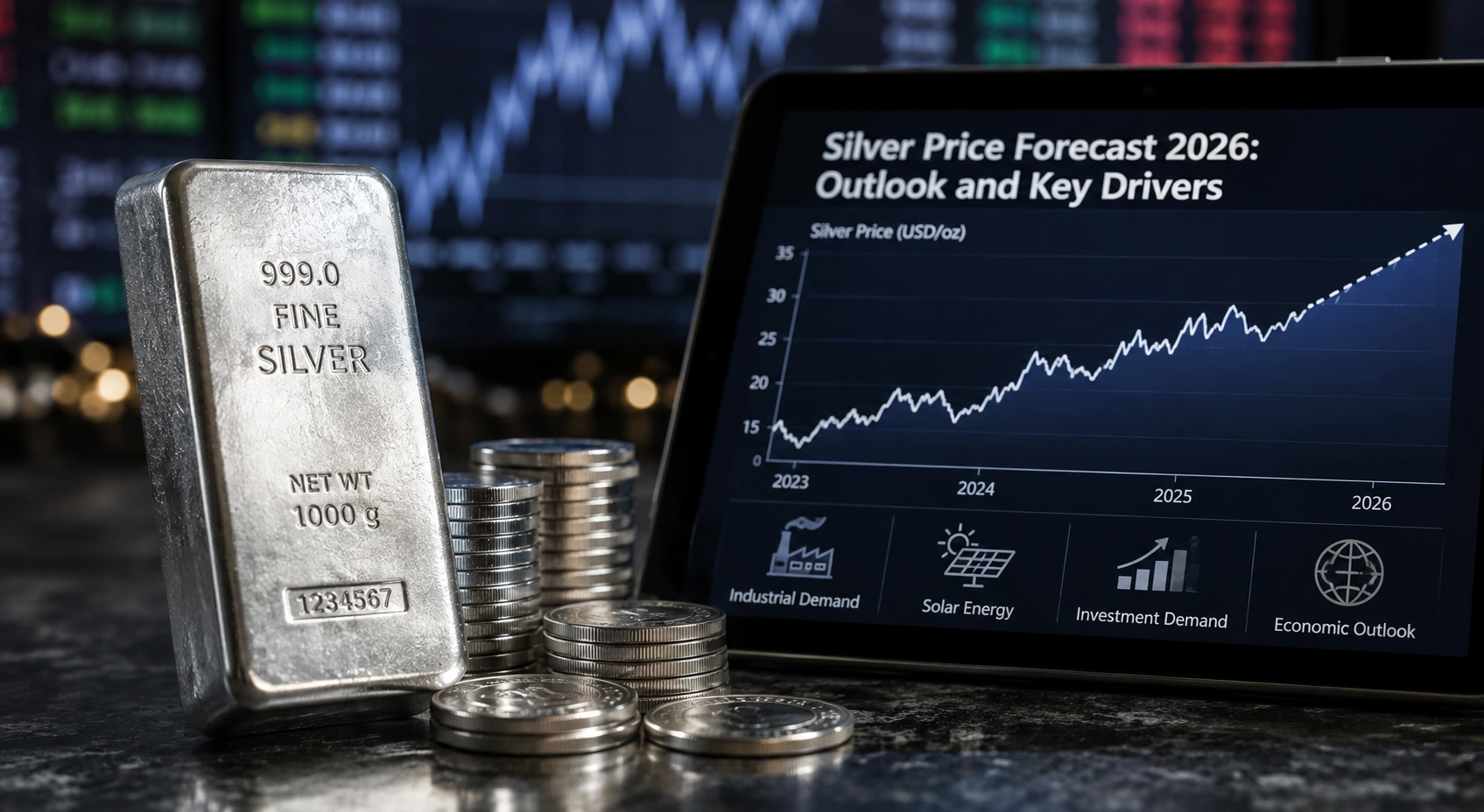
The silver price forecast remains a major topic for investors because silver has experienced unusually large price swings in 2026. Silver started the year with strong momentum and briefly moved above $100 per ounce before suffering a sharp correction. The Silver Institute reported that silver reached an all-time high above $121 on January 29 before falling back into the mid-$70s by early April. More recently, silver traded around the mid-$60s to high-$60s in August. These moves show how quickly sentiment can change.
The outlook remains mixed rather than certain. Some factors support higher silver prices, including tight physical supply, investment demand, and long-term industrial uses. Other factors could limit gains, including high interest rates, weaker industrial demand, and substitution in solar applications. J.P. Morgan Global Research expects silver to average about $70 per ounce in 2026 and sees a fourth-quarter price around $63. Its latest 2027 forecast also stands near $63 per ounce.
Silver Price Forecast for 2026
The current silver outlook suggests that volatility could remain high through the rest of 2026. J.P. Morgan Global Research recently reduced its 2026 average forecast from $84 to $70 per ounce. It expects silver to reach about $63 per ounce in the fourth quarter. The bank points to easing physical-market tightness and the possibility of higher global rates as factors that could limit the metal’s upside. This forecast does not mean silver must trade at exactly $63. Instead, it provides one institutional scenario based on current economic assumptions.
Other market conditions provide reasons for a more constructive view. The Silver Institute expects the global silver market to remain in deficit for a sixth consecutive year in 2026. Its February outlook projected a 67-million-ounce deficit and stronger physical investment. The Institute also expects total supply to rise, but not enough to eliminate the underlying shortage. This combination can provide price support if investor demand remains strong. However, silver can still experience sharp corrections even when supply-demand fundamentals look favorable.
What Is Driving the Silver Price?
Interest rates remain one of the most important factors in any silver price forecast. Silver does not generate interest income, so higher bond yields can make precious metals less attractive compared with interest-bearing assets. Expectations for Federal Reserve policy can therefore influence investor demand. When markets expect easier U.S. monetary policy, silver may receive support from lower yields and a potentially weaker dollar. When rate expectations move higher, precious metals can face pressure. Recent market movements have shown how quickly changing yield expectations can affect silver and other precious metals.
The U.S. dollar also plays an important role. Silver trades internationally in dollars, so changes in the dollar can influence its price for global buyers. A weaker dollar can make silver relatively cheaper for investors using other currencies and may support demand. A stronger dollar can create the opposite effect. Inflation expectations, economic growth, bond yields, and geopolitical risks can also change investor behavior. For this reason, a useful silver market analysis should examine monetary policy, currency trends, economic data, and investor positioning together instead of relying on one indicator.
Silver Supply and Demand Outlook
Supply remains an important part of the long-term silver price forecast. The Silver Institute expects global silver supply to increase in 2026, but it still forecasts a market deficit. Its February outlook projected total supply to rise by 1.5% to about 1.05 billion ounces. Mine production was expected to increase by around 1% to 820 million ounces. Recycling was also expected to rise as higher prices encourage consumers and businesses to sell more scrap silver. Even with these increases, the market could still need above-ground inventories to meet total demand. For more: USDJPY: Complete Guide to the USD/JPY Pair
The April 2026 World Silver Survey presented a somewhat different supply picture, forecasting a 2.5-million-ounce decline in mine supply for 2026. It also expects recycling to rise by 7%, supported by higher prices. These differences show why forecasts can change as new production data and market conditions emerge. The broader message remains important: silver supply responds slowly because new mines require years of development. This limited flexibility can make the market sensitive to sudden increases in investment or industrial demand.
Industrial Demand and Silver Prices
Industrial demand gives silver an important advantage over many other precious metals. Manufacturers use silver because of its strong electrical and thermal conductivity. The metal appears in electronics, automotive applications, power infrastructure, solar technology, and other industrial products. The Silver Institute expects data centers, artificial intelligence infrastructure, and automotive applications to support demand over time. These structural trends could provide a long-term foundation for silver consumption even when investment demand changes.
However, industrial demand does not guarantee higher prices. The Silver Institute expects industrial fabrication to decline in 2026, partly because solar manufacturers continue to reduce their silver usage. Producers can improve efficiency through a process known as thrifting, while some applications can replace silver with alternative materials. The Institute expects industrial fabrication to fall to around 650 million ounces in 2026. This creates an important balance for investors. Strong technology demand may support silver over the long term, but efficiency improvements can reduce the amount of silver required for each product.
Silver Price Forecast and Investment Demand
Investment demand can have a powerful effect on silver prices because investor purchases can change quickly. When investors become concerned about inflation, currency risks, geopolitical uncertainty, or financial markets, they may increase exposure to precious metals. The Silver Institute expects physical silver investment to rise by 20% in 2026 to about 227 million ounces. That would represent a three-year high and could provide additional support for prices if other demand categories weaken.
Investor behavior can also increase volatility. Silver has a smaller market than gold, so large changes in investment demand can produce significant price movements. The metal’s early-2026 rally demonstrated this effect, with prices reaching above $121 before experiencing a major correction. Investors should therefore avoid assuming that strong demand automatically creates a smooth upward trend. A silver price forecast should account for both bullish fundamentals and the possibility of rapid profit-taking. Price momentum can change quickly when traders react to interest rates, the dollar, or broader financial-market conditions.
Silver Price Forecast and the U.S. Dollar
The U.S. dollar is closely connected to silver because international silver prices usually appear in dollar terms. When the dollar weakens, silver can become more attractive to investors holding other currencies. A weaker dollar can also support broader demand for commodities. Conversely, a strong dollar can place pressure on silver because dollar-priced commodities become more expensive for international buyers. This relationship does not work perfectly every day, but it remains an important part of fundamental analysis.
Federal Reserve policy can influence both the dollar and silver at the same time. If markets expect interest rates to remain higher for longer, Treasury yields may rise and the dollar can gain support. That environment can make silver less attractive. If markets expect rate cuts, yields may decline and precious metals can benefit. Recent Reuters reporting showed silver moving alongside changing expectations for Federal Reserve policy and bond yields. Investors following the silver price forecast should therefore watch both the dollar index and U.S. Treasury yields.
Silver Price Forecast: Bullish and Bearish Scenarios
A bullish silver scenario would require several supportive conditions to develop together. Lower interest rates could improve precious-metal demand, while a weaker dollar could provide additional support. Strong physical investment could also tighten the market further. At the same time, continued demand from technology, automotive, power infrastructure, and artificial intelligence applications could strengthen the industrial side of the market. A prolonged supply deficit could amplify the effect if mine production fails to respond quickly.
A bearish scenario would look very different. Higher interest rates could increase the opportunity cost of holding silver, while a stronger dollar could pressure prices. Industrial demand could weaken further if global economic growth slows. Solar manufacturers may also continue reducing silver usage through thrifting and substitution. J.P. Morgan’s latest forecast reflects some of these concerns, with its 2026 average estimate at $70 and its fourth-quarter target near $63. These scenarios show why investors should avoid treating any single price target as a guarantee.
Silver Price Forecast for 2027
Forecasting silver for 2027 involves even more uncertainty than forecasting the remaining months of 2026. Economic conditions, central-bank policies, mine production, industrial technology, investment demand, and geopolitical events can all change significantly. J.P. Morgan Global Research currently expects silver to average around $63 per ounce in 2027. Its forecast reflects expectations that some of the exceptional tightness seen during the earlier rally will ease.
Long-term demand could still provide a strong foundation for the metal. The Silver Institute expects technology sectors such as artificial intelligence, data centers, electric vehicles, and power infrastructure to support industrial silver consumption through 2030. At the same time, manufacturers are becoming more efficient with silver usage. This creates a complicated long-term picture. Investors should therefore treat 2027 price targets as scenarios rather than precise predictions. Following updated supply, demand, and monetary-policy data can provide a more reliable view as the year approaches.
Is Silver a Good Investment in 2026?
Silver can offer diversification because its price responds to both precious-metal investment demand and industrial activity. That combination makes it different from assets that depend mainly on one economic factor. Investors may consider silver when they want exposure to precious metals, inflation concerns, or long-term technology trends. However, silver can experience much larger price swings than many investors expect. The early-2026 move above $121 followed by a major decline demonstrates the metal’s volatility.
The right approach depends on an investor’s goals, time horizon, and risk tolerance. Some investors prefer physical silver, while others use exchange-traded products or mining shares. Each option carries different risks and costs. Physical metal can involve storage and dealer spreads, while mining companies face operational and financial risks. Exchange-traded products can provide easier market access but still carry market risk. Before investing, readers should review related guides on silver investment strategies, precious metals diversification, and commodity risk management to understand the available choices.
Frequently Asked Questions
Will silver prices rise in 2026?
Silver could rise if investment demand stays strong, supply remains tight, and interest-rate conditions become more supportive. However, forecasts vary, and higher rates or weaker industrial demand could create additional downside pressure.
What is the silver price forecast for 2026?
J.P. Morgan Global Research currently expects silver to average about $70 per ounce in 2026, with a fourth-quarter forecast near $63. Other market factors could produce outcomes above or below this estimate.
What could make silver prices fall?
Higher interest rates, a stronger U.S. dollar, weaker economic growth, reduced industrial demand, and increased recycling could pressure silver prices. Stronger solar efficiency can also reduce silver consumption.
Why is industrial demand important for silver?
Silver has important electrical and thermal properties. Industries use it in electronics, vehicles, power infrastructure, solar technology, and other applications. Long-term technology growth could therefore support silver demand.
Is silver expected to remain volatile?
Yes. Silver has already experienced very large price movements in 2026. Its smaller market size, investment flows, changing interest-rate expectations, and industrial demand can all contribute to significant volatility.
Conclusion
The silver price forecast for 2026 remains uncertain, but several important forces could shape the market. Tight physical supply, investment demand, and long-term technology applications provide bullish arguments. At the same time, higher interest rates, a strong dollar, weaker industrial demand, and silver substitution in solar technology could limit gains. The Silver Institute expects another annual market deficit, while J.P. Morgan currently projects an average price of about $70 per ounce for 2026.
The best way to follow silver is to monitor several indicators rather than depend on one prediction. Watch Federal Reserve policy, U.S. Treasury yields, the dollar, investment demand, mine production, recycling, and industrial consumption. Silver can move quickly when these factors change. If you are researching precious metals, explore our related guides on silver investment, gold price forecasts, and commodity market trends to build a broader understanding before making financial decisions.