

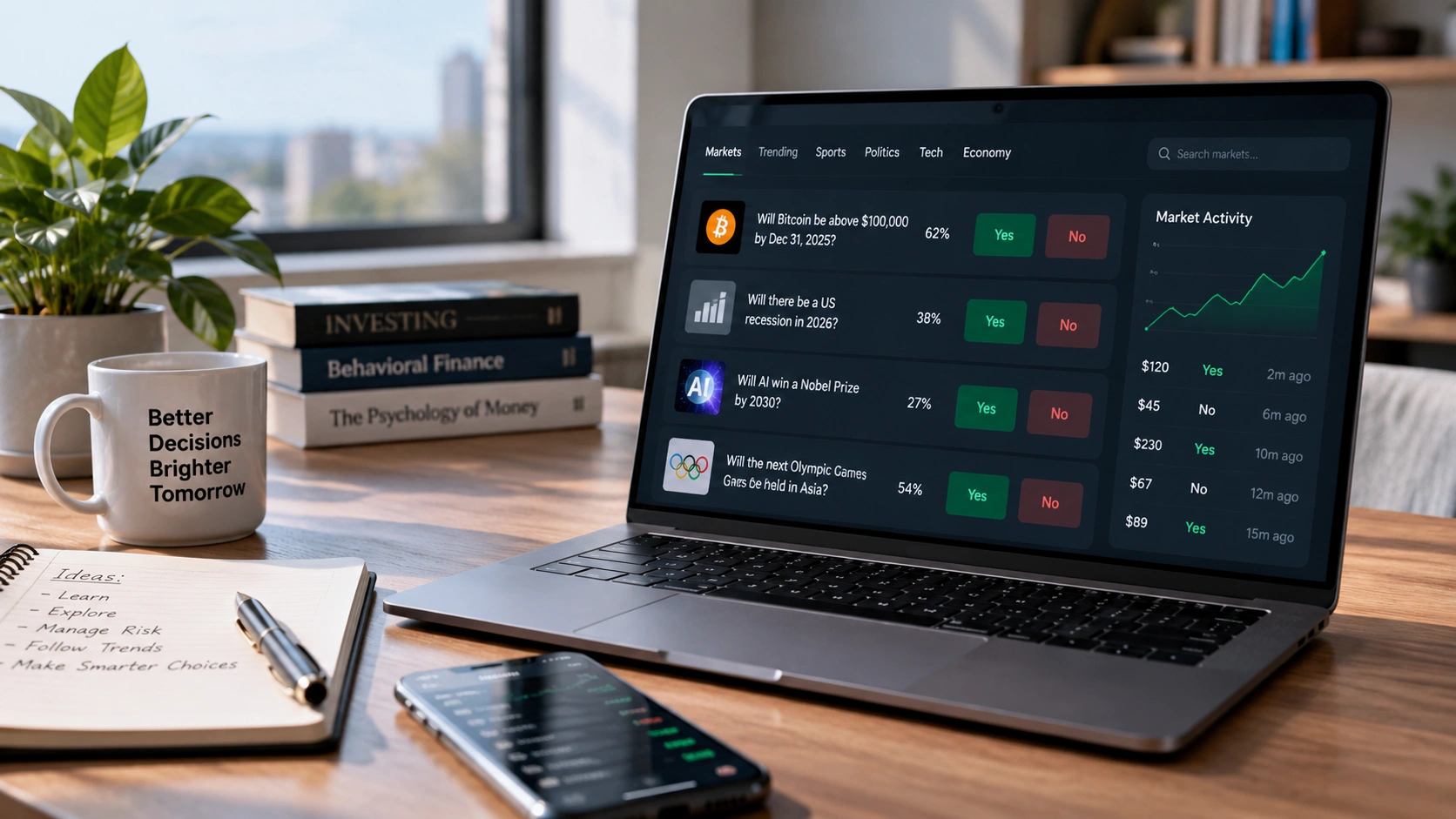
Prediction market platforms have become an interesting way to explore future events through market prices. Instead of relying only on traditional forecasts, these platforms allow participants to buy and sell contracts linked to possible outcomes. Prices change as traders respond to new information, creating a market-based view of what might happen. Some markets cover economic data, sports, entertainment, technology, and public events. Others focus on specialized questions with clearly defined results. For beginners, understanding how these markets operate is more important than choosing a platform immediately. This guide explains the main features, differences, costs, and risks to consider when exploring prediction markets. It also covers how to evaluate a platform carefully and recognize the limits of market-based forecasts.
What Are Prediction Market Platforms?
Prediction market platforms are online services where people trade contracts connected to future events. A contract may ask whether a particular event will happen by a specified date. For example, a market might ask whether a company will release a new product before the end of a year. Participants buy contracts based on their expectations, and the market price changes as buying and selling activity develops. When the event is settled, the contract pays according to its rules. Many contracts are designed around a simple yes-or-no outcome, although some markets use multiple possible results. The important point is that these markets turn expectations into tradable positions rather than presenting forecasts as ordinary articles or opinions.
A prediction market is not the same as a traditional stock exchange. Stocks represent ownership in companies, while event contracts are tied to specific outcomes. The value of an event contract depends primarily on the question being asked, the available information, and the rules used for settlement. Some platforms use centralized systems, while others operate through blockchain-based technology. Their features can differ considerably, including available markets, trading fees, payment methods, identity requirements, and geographic access. Understanding these differences helps users distinguish between a platform’s technology and the actual contract being traded. A familiar interface does not automatically mean that every market is reliable, liquid, or suitable for every participant.
How Do Prediction Markets Work?
The basic process begins with a clearly defined question and a settlement date. A platform creates a market that explains what outcome is being measured and how the final result will be determined. Traders then review the question and decide whether to buy or sell contracts. In a simple binary market, a contract may pay a fixed amount if the specified event occurs and nothing if it does not. The trading price reflects what participants are willing to pay for that potential payout. If a contract trades at $0.60, some traders may interpret that price as roughly a 60% market-implied probability, although this is not a guaranteed or perfectly accurate forecast.
Prices can move quickly when new information becomes available. A company announcement, economic report, unexpected injury, or change in a public schedule may influence how traders assess an outcome. When demand for one side increases, its price may rise; when traders become less confident, the price may fall. Some platforms use order books where buyers and sellers place orders at different prices. Others use automated market-making systems to provide liquidity. The exact mechanism affects trading costs and how easily a position can be opened or closed. Before participating, users should understand whether prices represent active bids, completed trades, or estimates generated by a market-making formula.
Key Features to Compare
One of the first things to examine is the range of markets available. Some services focus on a particular category, such as sports or financial indicators, while others offer a broader selection of event contracts. The quality of a market depends on more than the number of questions listed. A well-designed market should explain the outcome, deadline, and source of settlement information clearly. Users should also check whether contracts can be traded before the event is resolved. Early exit may be useful when circumstances change, but the available price can differ significantly from the amount originally paid. A large selection of markets is only useful when the questions are understandable and the rules are transparent.
Trading mechanics are equally important. A platform may offer limit orders, market orders, price charts, portfolio tracking, alerts, and transaction history. These features can help users understand their positions and avoid mistakes. However, a complicated interface may make it harder for beginners to recognize the actual costs of a trade. Look for clear information about spreads, commissions, withdrawal charges, and any other applicable fees. A platform should also explain what happens if a market is cancelled, a question becomes ambiguous, or the settlement source changes. Reading these details before trading can prevent misunderstandings that are difficult to resolve later.
Understanding Market Prices and Probabilities
A market price is often interpreted as an implied probability, but the relationship is not exact. In a simple contract that pays $1 if an event occurs, a price of $0.30 may suggest that traders collectively assign about a 30% chance to the outcome. This interpretation assumes the contract is fairly priced, the payout is understood, and trading conditions do not introduce major distortions. Real markets can include fees, limited liquidity, different risk preferences, and participants who trade for reasons other than pure probability estimation. As a result, a price should be treated as information about market expectations rather than a guaranteed prediction.
Consider a hypothetical market asking whether a company will achieve a particular sales target. The contract price may rise after strong quarterly results, but that does not prove the target will be reached. Traders could be reacting to the same public information, misunderstanding the question, or placing trades based on personal expectations. Prices can also move because a small number of transactions influence a thin market. Comparing the contract price with independent research, historical data, and the exact settlement rules can provide a more complete picture. This approach helps users understand what the market is suggesting without treating a single number as certainty.
Costs, Liquidity, and Trading Risks
Costs can have a meaningful effect on the outcome of a trade. Some platforms charge a transaction fee, while others earn revenue through spreads or other mechanisms. The spread is the difference between the price a buyer is willing to pay and the price a seller is willing to accept. In a market with limited activity, this difference may be relatively large. A user who buys and sells frequently could lose money through trading costs even when the market moves in the expected direction. Checking the complete fee schedule is therefore an important part of comparing prediction market platforms. For more: Online Trading Platforms: How to Choose the Best One
Liquidity refers to how easily contracts can be bought or sold without causing a large price change. A market with many active participants may offer more opportunities to enter or exit at reasonable prices. A thin market can be harder to trade, especially when a user wants to close a larger position. There is also the risk that a contract will settle differently from what a participant expected because of its wording or source of verification. Other risks include platform outages, payment restrictions, technical problems, and possible loss of funds. No platform can eliminate uncertainty simply by displaying a market price.
Legal Access and Platform Reliability
Legal access is an important consideration because prediction markets may be regulated differently depending on the country, contract type, and operator. A platform available in one jurisdiction may not accept users from another. Rules can also vary between event categories, particularly when contracts involve sports, financial outcomes, or public affairs. Before opening an account, users should review the platform’s eligibility requirements and applicable restrictions. They should not assume that access through a website or mobile application means that trading is legally available in their location.
Reliability involves more than whether a website loads correctly. A trustworthy service should explain its ownership, operating model, account requirements, and customer support process. It should provide clear information about how funds are held, how withdrawals work, and what happens during a dispute. Blockchain-based platforms may offer additional transparency through public transaction records, but that does not remove the need to evaluate smart-contract risks or the organization behind the service. Users should also consider whether the platform has a documented process for correcting errors and resolving unclear market outcomes.
Choosing a Platform for Your Needs
The right platform depends on what a user wants to understand or accomplish. Someone interested in learning about event-based trading may prefer a service with educational material, simple contract explanations, and a practice environment. Another user may care more about a particular market category, payment options, or the ability to track positions across several questions. These preferences should be evaluated separately rather than assuming that one platform is suitable for everyone. A clear interface and transparent rules can be useful starting points for beginners, but they do not replace careful research.
A practical comparison can begin with a short checklist:
- Market selection: Does the platform offer questions that match your interests?
- Contract rules: Are outcomes, deadlines, and settlement sources clearly explained?
- Costs: Are trading, withdrawal, and other fees easy to find?
- Liquidity: Can contracts be bought or sold at reasonable prices?
- Access: Is the service available and permitted in your jurisdiction?
- Security: Does it explain account protection and fund management?
- Support: Is there a clear process for resolving problems?
These factors help separate the platform’s features from the risks of the underlying market. A service with many contracts may still be difficult to use if its settlement rules are unclear. Similarly, low fees may not compensate for poor liquidity or limited support. Beginners can benefit from comparing a few platforms carefully, reading the terms, and understanding the mechanics of one contract before exploring more complicated markets.
Practical Steps for Beginners
Before placing a trade, start by reading the complete question and its settlement conditions. Identify the event being measured, the deadline, and the source that will determine the final result. If the wording is unclear, do not rely on assumptions about what the platform probably means. Check whether the contract can be traded after purchase and whether there are restrictions on closing a position. It is also useful to review the current price, recent price movement, and available trading volume. These details help explain the market’s current conditions without suggesting that past movements guarantee future results.
Beginners should consider using a small learning budget and avoiding money needed for essential expenses. A written record of the reason for each trade can make it easier to evaluate decisions later. For example, a user might record the information available at the time, the expected outcome, and the conditions that would change that expectation. This creates a more disciplined learning process than reacting to every price movement. It is also important to recognize that event contracts can produce losses, and a series of successful predictions does not guarantee future success. The purpose of early participation should be understanding the market, not chasing quick returns.
Frequently Asked Questions
Are prediction market platforms legal?
Legality depends on the jurisdiction, the operator, and the type of event contract. Check the platform’s eligibility requirements and applicable local rules before using a service.
How do prediction markets make money?
Platforms may earn revenue through trading fees, spreads, or other charges. The exact model depends on the service, so review its fee schedule before trading.
Can beginners use prediction markets?
Beginners can learn how these markets work by studying contract rules, prices, and settlement procedures. Starting with education and limited exposure can help reduce avoidable mistakes.
Are market predictions always accurate?
No. Market prices reflect participant expectations and can be affected by incomplete information, limited liquidity, and other factors. They should not be treated as certain outcomes.
What should I check before choosing a platform?
Review market selection, settlement rules, trading costs, liquidity, account requirements, security practices, and legal availability. Clear documentation is especially important for first-time users.
Conclusion
Prediction market platforms offer a different way to explore uncertainty by connecting future events with tradable contracts. Their value comes from the information and expectations reflected in market prices, but those prices are not guarantees. Understanding contract wording, settlement rules, costs, liquidity, and legal access is essential before participating. Beginners can start by comparing platform features, studying a few example markets, and keeping their financial exposure limited. For further learning, explore related content about financial market basics, risk management, and how trading fees affect returns. With a careful approach, prediction markets can become a useful subject for learning about probabilities, information, and decision-making.


1 Comment