
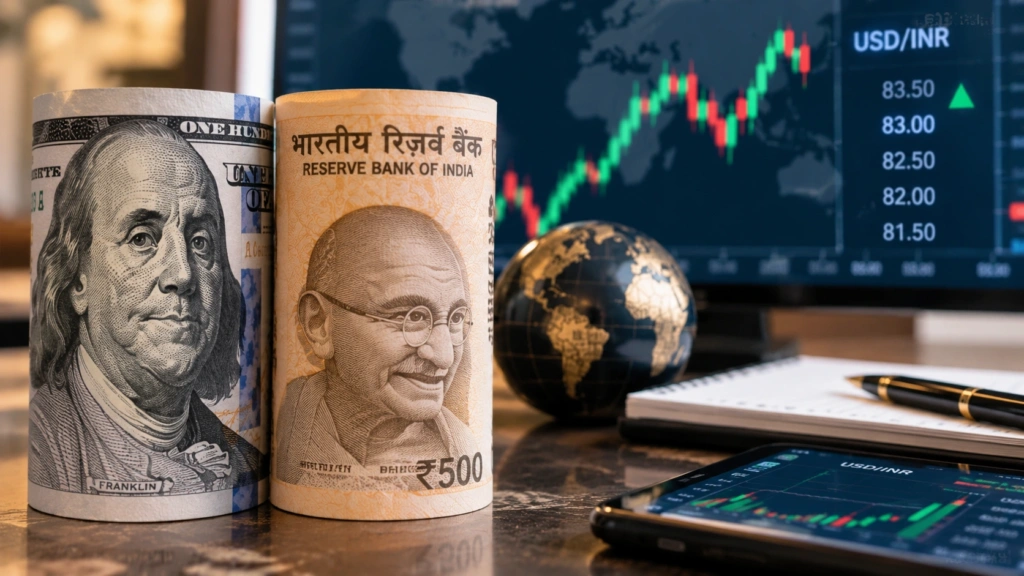
The USD in INR forecast is closely watched by investors, businesses, importers, exporters, and people sending money between the United States and India. The exchange rate has remained sensitive to global interest rates, crude oil prices, foreign investment flows, and Reserve Bank of India (RBI) intervention. In early September 2026, the rupee was trading around the mid-₹95 area against the U.S. dollar, while recent forecasts point to a relatively stable but uncertain path.
Forecasting currencies is never an exact science. Instead, a useful forecast combines current price action with economic data, central-bank policy, trade conditions, and market sentiment. This guide explains what the latest outlook means and which factors could push USD/INR higher or lower.
USD in INR Forecast: What the Current Outlook Shows
The latest market picture suggests that USD/INR could remain relatively range-bound in the near term, although volatility can increase quickly when global conditions change. On September 4, the rupee strengthened to about ₹95.38 per dollar, while India’s foreign-exchange reserves reached a record $740.80 billion for the week ending August 28. Strong foreign-currency inflows have given the RBI additional capacity to stabilize the currency.
Different forecasting models produce different results because they use different assumptions. One current forecast places USD/INR around 95.25 for September 2026 and 95.46 by December, while another model gives a September monthly average near 95.72 and a December average around 97.02. These differences show why investors should treat currency forecasts as scenarios rather than guaranteed targets.
What Could Drive USD/INR Higher?
A stronger U.S. dollar is one of the clearest risks for the Indian rupee. If U.S. interest rates remain elevated, global investors may prefer dollar-denominated assets because they can offer attractive yields. Recent U.S. employment data have also influenced expectations around Federal Reserve policy, with some analysts pushing expected rate cuts further into 2027. A higher-for-longer U.S. rate environment can support the dollar and place pressure on emerging-market currencies such as the rupee.
Crude oil is another major consideration. India imports a substantial amount of its energy needs, so higher oil prices can increase demand for dollars to pay for imports. In September 2026, renewed geopolitical tensions helped push Brent crude toward $97 per barrel, creating additional pressure on the rupee. If oil moves significantly higher, USD/INR could face upward pressure even if other parts of the Indian economy remain strong.
Why the Indian Rupee Could Strengthen
The rupee also has several potential sources of support. India’s record foreign-exchange reserves provide a substantial buffer during periods of market stress, while recent foreign-currency inflows have strengthened the country’s external position. Reuters reported that India’s reserves reached $740.80 billion at the end of August, following a large increase in foreign-currency deposits and related inflows. For more: Bear Flag Pattern: Meaning, Setup & Trading Guide
RBI intervention can also reduce sudden movements in USD/INR. The central bank has been active in the foreign-exchange market, helping limit the impact of higher oil prices and stronger U.S. yields. In early September, market participants expected USD/INR to remain around the ₹94.50–₹95.50 area under favorable conditions, although this range can change if global risks intensify.
USD in INR Forecast for 2026
For the remainder of 2026, the outlook is mixed rather than strongly one-directional. A September forecast from ExchangeRates.org.uk places USD/INR at about 95.25 and projects approximately 95.46 for December. Its broader provider-based range for the fourth quarter extends from roughly 92.59 to 98.04, highlighting considerable uncertainty around the central estimate.
Another forecasting model is more cautious about the rupee, projecting monthly averages of about 95.72 in September, 96.04 in October, 96.51 in November, and 97.02 in December. This demonstrates an important point for anyone researching the USD in INR forecast: two reasonable models can produce noticeably different numbers because exchange rates depend on variables that are difficult to predict several months ahead.
USD/INR Technical Outlook and Important Levels
From a market perspective, the ₹95 area has become an important reference point. USD/INR had reached nearly 95.76 in August before retreating toward the ₹95.15 region as selling pressure emerged. A September technical forecast identifies approximately 94.85 to 96.50 as a speculative range, although actual trading can move outside any projected range when major economic or geopolitical news arrives.
For beginners, it is better to think of support and resistance as zones rather than precise predictions. If USD/INR repeatedly holds above a support area, buyers may remain interested in the dollar. Conversely, a sustained move below important support can indicate greater rupee strength. Traders should combine these technical signals with the economic calendar, especially U.S. inflation, Federal Reserve decisions, Indian inflation, oil prices, and RBI announcements.
How Interest Rates Affect the USD in INR Forecast
Interest-rate differences between the United States and India can strongly influence currency demand. When U.S. rates are attractive relative to other markets, international capital can move toward dollar assets. This can increase demand for USD and potentially push USD/INR higher. Conversely, expectations of easier U.S. monetary policy can weaken the dollar and provide some support for the rupee.
The current situation is particularly uncertain because expectations for Federal Reserve policy have been changing. A Reuters poll in early September noted that the dollar could remain firm in the short term but potentially weaken over the following year, while strong U.S. employment data had reduced expectations for near-term rate cuts. This is why investors should watch Fed communication rather than relying only on a single forecast number.
How Businesses and Investors Can Use the Forecast
A USD/INR forecast can be useful for more than currency traders. Indian importers may use the outlook when estimating the future cost of goods purchased in dollars, while exporters can consider how currency movements may affect their revenues. Companies with significant foreign-currency exposure often use hedging strategies to reduce the financial impact of unexpected exchange-rate movements.
For individuals, the practical question may be even simpler: when is the best time to convert USD to INR? There is no universally correct answer because the exchange rate can change rapidly. Someone receiving a regular dollar income might consider converting in stages rather than trying to predict the exact market top or bottom. For more information, related resources on currency conversion, forex risk management, and USD exchange rates can provide useful background.
What Could Change the USD in INR Forecast?
The biggest risk to any currency forecast is an unexpected event. Geopolitical tensions, a sharp rise in crude oil, changes in U.S. monetary policy, large foreign-investor flows, or unexpected Indian economic data can quickly alter market expectations. For example, recent tensions in West Asia pushed oil prices higher, but RBI intervention and strong foreign-currency inflows helped prevent a major decline in the rupee.
India’s domestic economic performance is another important factor. Recent data showed India’s economy expanded by 7.8% in the April–June quarter of 2026, leading several economists to raise their FY27 growth expectations. Strong economic growth can support investor confidence, although inflation, weak monsoon conditions, oil costs, and global financial tightening remain potential risks.
USD in INR Forecast: Bullish, Bearish, or Stable?
The most balanced interpretation of the current USD in INR forecast is that USD/INR may remain volatile but broadly controlled in the near term. RBI intervention, large foreign-exchange reserves, and strong capital inflows provide support for the rupee. At the same time, elevated oil prices, potential U.S. rate increases, and geopolitical uncertainty can create upward pressure on USD/INR.
Rather than choosing one exact target, investors should consider several scenarios. A stronger dollar and expensive oil could push USD/INR toward the upper end of forecast ranges. More favorable global conditions, lower oil prices, and continued capital inflows could support the rupee and keep the pair closer to the lower end. Current forecasts illustrate this wide range of possible outcomes rather than a single certain future price.
FAQ
What is the USD in INR forecast for 2026?
Current forecasts vary. One September 2026 forecast puts USD/INR near 95.25 and December near 95.46, while another projects monthly averages rising toward about 97.02 in December. Forecasts should be treated as estimates, not guarantees.
Will USD/INR go above ₹96?
It is possible, particularly if the U.S. dollar strengthens, oil prices remain elevated, or global risk sentiment deteriorates. Some current forecast ranges already extend above ₹96, showing that such a move is within the range of plausible scenarios.
Can the Indian rupee strengthen against the dollar?
Yes. Strong capital inflows, RBI intervention, high foreign-exchange reserves, and improving investor confidence can support the rupee. Recent trading has already shown periods of rupee appreciation against the dollar.
What factors affect USD/INR the most?
Major factors include Federal Reserve interest-rate policy, RBI policy and intervention, crude oil prices, foreign investment flows, India’s trade balance, inflation, economic growth, and geopolitical developments.
Is a USD in INR forecast reliable?
No forecast is completely reliable. Currency markets respond to new information continuously, so forecasts can change quickly. It is better to use a forecast as one input alongside current exchange rates, economic data, technical levels, and risk-management plans.
Conclusion
The USD in INR forecast for 2026 points to a market that could remain relatively stable in some periods but highly sensitive to global developments. Current estimates generally place USD/INR around the mid-₹95 area in the near term, while longer projections vary considerably. RBI intervention and India’s strong reserve position offer meaningful support to the rupee, but oil prices, U.S. interest rates, capital flows, and geopolitical risks remain important sources of uncertainty.
For anyone tracking USD/INR, the best approach is to focus on the factors behind the forecast rather than a single price target. Keep an eye on RBI and Federal Reserve decisions, crude oil, inflation, foreign investment, and major economic data before making currency-related decisions.