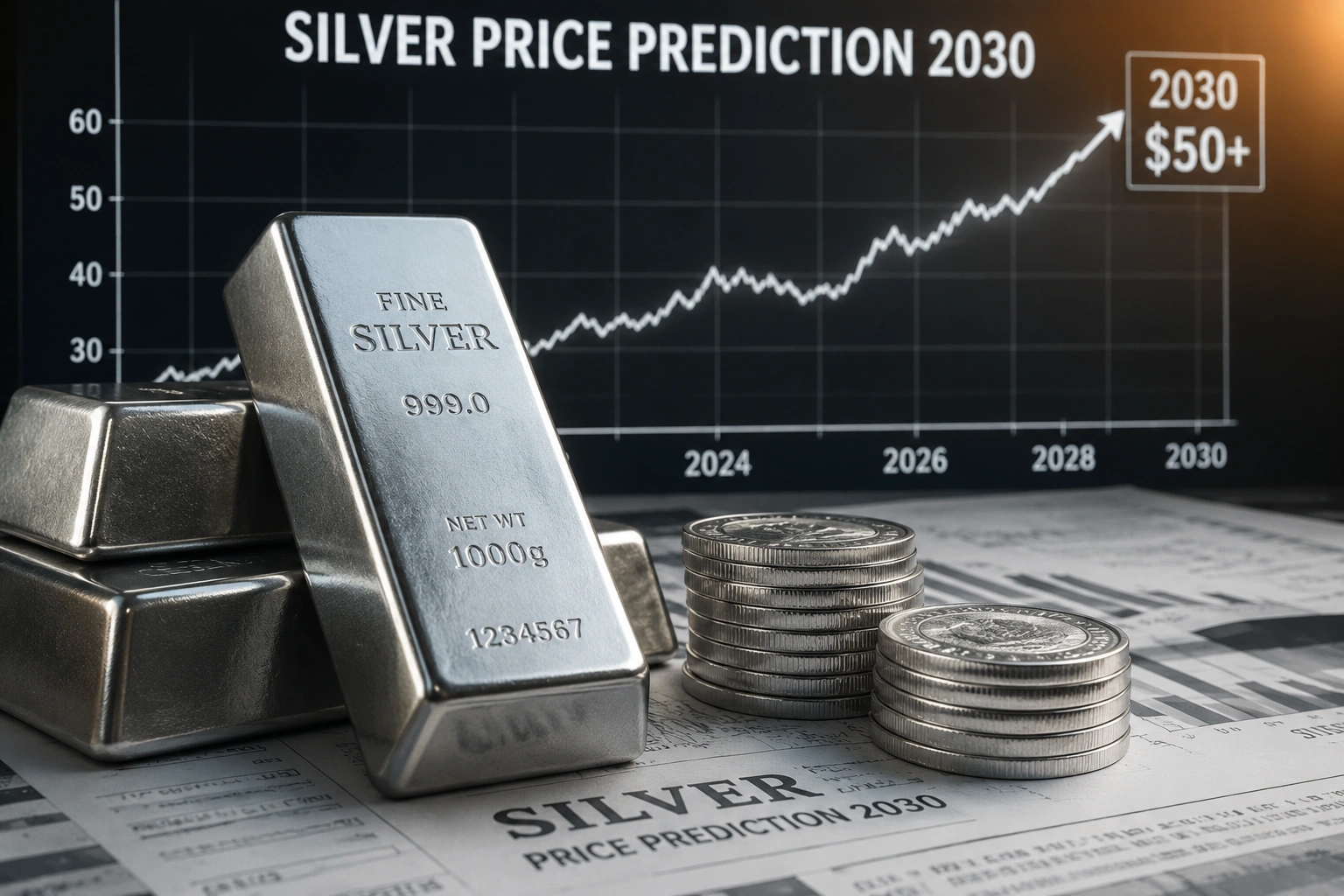
The silver price prediction 2030 is becoming increasingly important for investors who want to understand where the precious-metals market could be heading over the next several years. Silver is unique because it serves two major purposes: it is a precious metal used for investment, and it is an industrial commodity used in technology and manufacturing. This combination means its future price can respond to inflation, interest rates, economic growth, mining supply, investor sentiment, solar energy, electric vehicles, electronics, and global industrial activity. Because conditions can change considerably before 2030, forecasts should be treated as possible scenarios rather than guaranteed prices.
Silver’s long-term outlook is particularly interesting because demand is expanding in several technology-driven industries while supply remains relatively difficult to increase quickly. Solar panels, electrical equipment, vehicles, electronics, and other applications require silver because of its excellent electrical conductivity and other physical properties. At the same time, investment demand can rise when investors become concerned about inflation, currencies, financial instability, or geopolitical uncertainty. These factors can work together to create strong price movements. However, silver is also highly volatile, meaning investors should expect significant corrections and periods of weakness even if the broader long-term trend eventually becomes positive.
Why Silver Could Be Important by 2030
Silver could become increasingly important by 2030 because the global economy is becoming more dependent on technologies that require reliable electrical and electronic components. Solar power is one of the most important examples. Silver is used in photovoltaic cells to conduct electricity, and the continued expansion of renewable energy could support substantial demand. Electric vehicles, charging systems, advanced electronics, data centers, and telecommunications equipment can also require silver. These applications create a different demand profile from traditional precious metals because the metal is actually consumed during manufacturing. This structural industrial demand could provide a long-term foundation for the silver market.
However, growing demand does not automatically guarantee higher prices. Manufacturers have strong incentives to reduce the quantity of silver used in products whenever the metal becomes expensive. Solar manufacturers, for example, have been working on silver thrifting and substitution to control costs and improve efficiency. The Silver Institute has reported that these developments have already affected photovoltaic silver demand. This means investors should consider both total product growth and the amount of silver required per product. If global solar installations increase rapidly but manufacturers dramatically reduce silver use per cell, the resulting demand growth could be much smaller than headline installation numbers suggest.
Silver Price Prediction 2030 and Industrial Demand
Industrial demand is likely to remain one of the most important factors behind the silver price prediction 2030. Silver’s electrical conductivity makes it valuable in electronics, electrical systems, automotive components, solar technology, and various specialized applications. The expansion of digital infrastructure could add another source of demand as businesses build data centers, communication networks, and high-performance computing systems. These industries may not all grow at the same speed, but together they create a broad industrial foundation for silver consumption. Unlike gold, which is primarily valued for investment and jewelry, silver’s industrial role gives it exposure to real economic activity. For more: How Much Is a Bar of Gold Worth Today?
Solar energy deserves special attention because photovoltaic technology has become an important source of silver consumption. The growth of renewable-energy installations could continue supporting demand through the end of the decade. Electric vehicles are another potential driver because modern vehicles contain numerous electrical contacts, control systems, and electronic components. Research commissioned by the Silver Institute has projected continued growth in automotive silver demand through 2031. These trends suggest that industrial applications could remain a significant part of the silver market by 2030, although efficiency improvements and material substitution remain important risks to this outlook.
Silver Supply and Mining Outlook
Silver supply is another major factor investors should watch when considering the silver price prediction 2030. Unlike commodities where production can sometimes respond quickly to higher prices, silver production has unique limitations. A large portion of global silver output is produced as a by-product of mining other metals, including lead, zinc, copper, and gold. This means a higher silver price does not necessarily provide mining companies with an immediate reason to dramatically increase silver production. New mines can require years of exploration, financing, permitting, construction, and development before they produce meaningful quantities of metal.
Recycling provides another source of silver supply and becomes increasingly important when prices rise. Jewelry, industrial scrap, electronic components, and other materials can return silver to the market when recycling becomes economically attractive. Higher prices may therefore encourage more recycling and reduce some supply pressure. Nevertheless, recycling cannot always respond immediately to changing market conditions, and not every silver-containing product is economical to recycle. This creates a complicated relationship between price and supply. If industrial demand grows faster than mine production and recycling, the market could experience tighter physical conditions, potentially creating upward pressure on prices.
Bullish Silver Price Prediction 2030 Scenario
A bullish silver price prediction 2030 would involve several favorable conditions developing simultaneously. Strong industrial growth would increase demand for silver in solar power, electric vehicles, electronics, and other technologies. At the same time, limited mine-supply growth could make it difficult for producers to satisfy rising consumption. Investment demand could provide an additional catalyst if inflation remains elevated, real interest rates fall, or investors seek protection from economic and geopolitical uncertainty. Under such conditions, silver could experience sustained upward pressure as industrial users and financial investors compete for available metal.
A particularly strong bullish environment could develop if physical shortages become persistent while investment demand increases rapidly. Silver has a relatively small market compared with many major financial assets, so changes in investor positioning can produce significant price movements. However, even a bullish scenario would probably involve considerable volatility. Silver can rise quickly and then experience sharp corrections as traders take profits or macroeconomic conditions change. Therefore, investors should not interpret a bullish 2030 scenario as evidence that silver will rise continuously. A long-term positive trend could still include several major declines along the way.
Bearish Silver Price Prediction 2030 Scenario
A bearish silver price prediction 2030 would emerge if several negative factors affected the market simultaneously. Weak global economic growth could reduce industrial consumption, particularly if manufacturing activity slows. Higher interest rates could also make precious metals less attractive because investors have more opportunities to earn returns from interest-bearing assets. A stronger U.S. dollar could create additional pressure because internationally traded silver becomes more expensive for buyers using other currencies. Falling investment demand could then amplify the weakness created by lower industrial consumption.
Technology could also create challenges for silver demand. Manufacturers have a strong financial incentive to use less silver when prices rise, particularly in large-scale applications such as solar photovoltaic production. Substitution with alternative materials could reduce silver consumption in some products. Increased recycling could provide additional supply if elevated prices encourage consumers and businesses to recover previously used metal. If these developments occur alongside increased mine production, the supply-demand balance could become less supportive. In that situation, silver could remain volatile or even decline despite long-term growth in some industrial applications.
What Could Silver Be Worth in 2030?
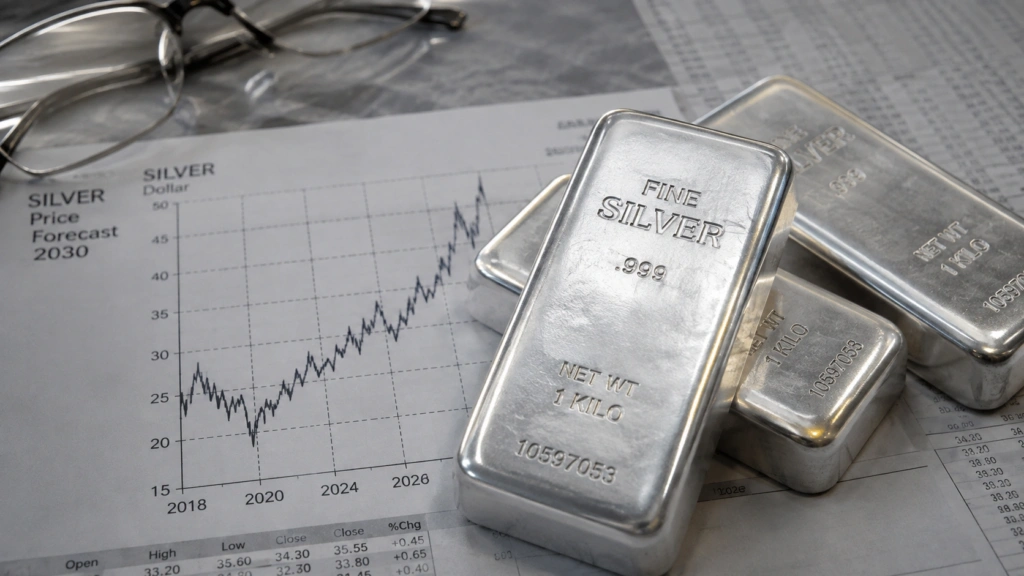
There is no universally accepted silver price prediction 2030 that can accurately establish a single future price. Long-range forecasts are inherently uncertain because economic conditions, technology, monetary policy, mining activity, and investor behavior can change substantially. Professional market analysts often focus more heavily on shorter forecasting periods because uncertainty becomes greater as the prediction horizon expands. For this reason, investors should be skeptical of websites or commentators that present one precise 2030 silver price as though it were certain. A range of potential outcomes is generally more useful for long-term planning.
A practical way to think about the 2030 silver outlook is through three scenarios: conservative, base, and bullish. A conservative scenario could involve slower industrial growth, successful substitution, increased recycling, and relatively high interest rates. A base scenario could assume continued industrial demand growth, moderate supply constraints, and normal investment interest. A bullish scenario could involve strong electrification, expanding solar installations, limited mining growth, and significant investor demand. The actual silver price could fall outside any of these scenarios because unexpected events can strongly influence commodity markets. Therefore, the best forecast is one that recognizes uncertainty rather than pretending it does not exist.
Interest Rates, Inflation, and Silver Prices
Interest rates could play a major role in determining silver’s investment demand through 2030. Silver does not generate interest or dividends when held as physical metal, so its relative attractiveness can change depending on the returns available from other assets. When real interest rates are high, investors may prefer bonds or cash-generating assets. When real rates decline, precious metals can become comparatively more attractive. Central-bank monetary policy, inflation expectations, and economic growth therefore deserve attention when analyzing long-term silver forecasts.
Inflation is another important consideration because precious metals have historically attracted investors seeking protection from declining purchasing power. However, silver does not always move higher simply because inflation rises. The strength of the currency, interest-rate response, economic growth, and investor sentiment all influence the final outcome. If inflation rises sharply but central banks respond with aggressive rate increases, silver could face competing pressures. Conversely, persistent inflation combined with falling real yields and strong precious-metal investment demand could create a much more supportive environment for silver prices.
Gold and the Silver Price Prediction 2030
Gold can provide useful context when evaluating the silver price prediction 2030 because the two metals often respond to similar macroeconomic forces. Investors frequently compare them using the gold-to-silver ratio, which measures how many ounces of silver are needed to purchase one ounce of gold. When investor interest in precious metals increases, both metals can benefit, although silver often experiences larger percentage movements because its market is smaller and more closely connected to industrial activity.
The relationship is not perfectly predictable, however. Gold is primarily influenced by monetary conditions, central-bank activity, investment demand, and safe-haven flows, while silver has much greater exposure to manufacturing and technology. This means silver can outperform gold during periods of strong industrial growth but can also underperform when economic activity weakens. Investors researching long-term precious metals may therefore benefit from comparing a gold price forecast, the gold-to-silver ratio, and industrial silver-demand trends rather than analyzing silver independently.
Key Risks to the Silver Outlook
One of the biggest risks to a bullish silver forecast is technological substitution. When silver prices increase, manufacturers have a clear incentive to reduce their dependence on the metal. Solar companies have already demonstrated this behavior by developing ways to use less silver in photovoltaic cells. If technological progress allows manufacturers to substantially reduce silver intensity across several industries, overall demand could grow more slowly than expected even when the number of products being manufactured increases.
Another risk is a global economic slowdown. Because silver has significant industrial applications, weaker manufacturing activity can reduce physical demand. Higher interest rates can simultaneously reduce investment interest in precious metals. Supply could also surprise the market if mining output grows faster than expected or recycling becomes more economical. These risks do not necessarily invalidate the long-term silver investment case, but they demonstrate why investors should regularly reassess the market rather than relying on a forecast created several years before 2030.
Should You Invest in Silver for 2030?
Silver may appeal to investors who want exposure to both precious-metal markets and long-term industrial trends. However, it should not automatically be considered suitable for every portfolio. Silver prices can experience substantial volatility, and physical silver may involve dealer premiums, storage expenses, insurance costs, and taxes depending on the investor’s location. Financial products that track silver can have different fees and structures. Mining companies introduce another layer of risk because their performance depends on operating costs, management, financing, political conditions, and other metals they produce.
A sensible long-term approach is to consider silver as part of a broader investment strategy rather than making decisions based entirely on a single 2030 price target. Investors should examine their financial objectives, risk tolerance, investment horizon, and existing portfolio before deciding how much exposure they want. It is also useful to monitor updated information about silver production, industrial consumption, recycling, interest rates, inflation, and investor flows. A strong investment thesis should be regularly tested against new evidence rather than defended regardless of changing market conditions.
Silver Price Prediction 2030: What Investors Should Watch
Investors following the silver price prediction 2030 should monitor several indicators instead of focusing only on the daily price chart. Mine production can reveal whether supply is expanding, while recycling data can show how much additional metal is returning to the market. Industrial fabrication demand can indicate whether manufacturing consumption is accelerating. Solar silver usage is particularly important because efficiency improvements could significantly change the amount of silver required by the renewable-energy sector.
Macroeconomic conditions are equally important. Interest rates, inflation expectations, the U.S. dollar, gold prices, global manufacturing activity, and geopolitical developments can all influence silver’s investment demand. Automotive electrification and data-center expansion are also worth following because they represent potential sources of long-term industrial consumption. By combining these indicators, investors can develop a more balanced understanding of the market. This approach is generally more useful than following sensational headlines claiming that silver must reach a specific price by 2030.
Frequently Asked Questions
What is the silver price prediction 2030?
The silver price prediction 2030 cannot be known with certainty because the market will depend on supply, industrial demand, investment flows, interest rates, inflation, technology, and global economic conditions. Long-term scenarios are more useful than relying on one exact price target.
Could silver reach $100 by 2030?
Silver could potentially reach $100 per ounce under an exceptionally bullish combination of strong demand, limited supply, monetary easing, and substantial investment interest. However, reaching that level is not guaranteed, and higher prices could encourage more recycling and substitution.
Why could silver prices rise by 2030?
Silver could benefit from expanding solar power, electric vehicles, electronics, data centers, and other technologies. Limited mining flexibility could add another source of upward pressure if demand grows faster than available supply.
What could make silver prices fall before 2030?
Higher interest rates, weaker industrial activity, a stronger dollar, lower investment demand, increased recycling, greater mine production, and technological substitution could all place downward pressure on silver prices.
Is silver a good investment for 2030?
Silver could offer long-term opportunities, but it also carries substantial volatility and does not guarantee returns. Whether it is appropriate depends on an investor’s goals, risk tolerance, time horizon, and overall portfolio diversification.
Conclusion
The silver price prediction 2030 remains uncertain, but the long-term market has several important factors worth watching. Industrial demand from solar energy, electric vehicles, electronics, and emerging technologies could provide meaningful support, while silver’s complex mining structure may limit how quickly supply can respond. Investment demand could add further momentum when inflation, monetary policy, or geopolitical uncertainty increases interest in precious metals.
At the same time, investors should recognize the risks. Manufacturers can reduce silver usage, substitute alternative materials, increase recycling, and adjust production when prices become expensive. Economic slowdowns and high interest rates can also weaken demand. Rather than depending on one headline forecast, follow the underlying supply-demand balance and broader economic indicators. Reviewing updated silver market forecasts, industrial trends, and precious-metal data can help you make a more informed decision as 2030 approaches.