

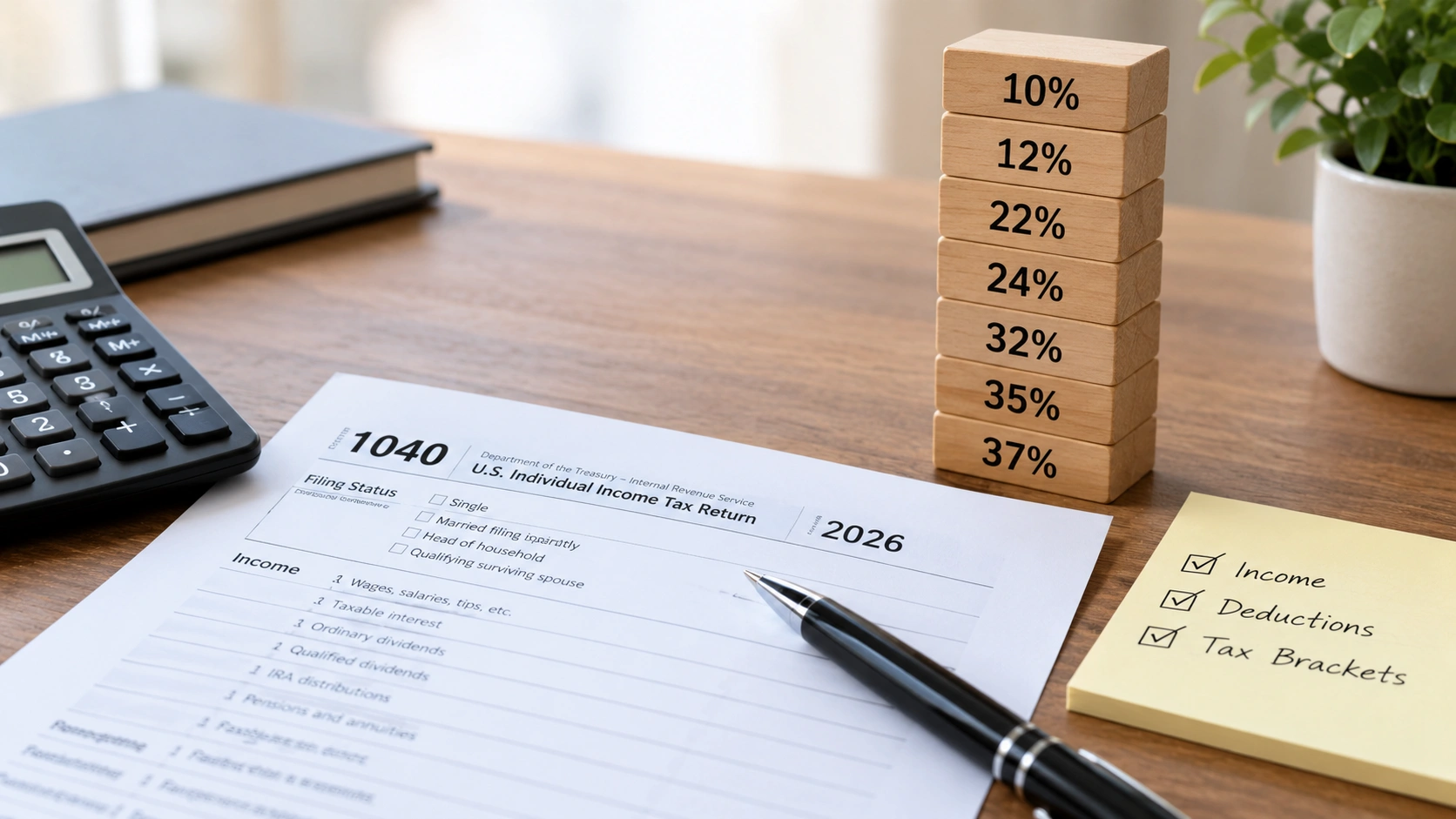
The 2026 federal tax brackets determine the marginal federal income tax rates applied to taxable income earned during 2026. The IRS has set seven federal income tax rates for the year: 10%, 12%, 22%, 24%, 32%, 35%, and 37%. The brackets are adjusted annually for inflation, so the income thresholds for 2026 are different from those used for 2025.
One important point is that moving into a higher bracket does not mean all of your income is taxed at that higher rate. Federal income tax uses a marginal system, meaning each portion of taxable income is taxed according to the bracket it falls into. Understanding this distinction can make it much easier to estimate your federal tax liability and plan deductions, withholding, and other tax decisions.
2026 Federal Tax Brackets at a Glance
The 2026 federal tax brackets range from 10% to 37%. For single taxpayers, the 10% bracket applies to taxable income up to $12,400, while the top 37% rate begins above $640,600. For married couples filing jointly, the 10% bracket extends to $24,800 and the 37% rate begins above $768,700.
The exact thresholds depend on filing status. Head-of-household taxpayers have different bracket limits from single taxpayers, while married taxpayers filing separately generally use the same thresholds as single filers. These figures apply to taxable income, not simply your total salary or gross income. Your taxable income can be reduced by eligible deductions before the federal tax brackets are applied.
| Tax Rate | Single | Married Filing Jointly |
|---|---|---|
| 10% | Up to $12,400 | Up to $24,800 |
| 12% | $12,400–$50,400 | $24,800–$100,800 |
| 22% | $50,400–$105,700 | $100,800–$211,400 |
| 24% | $105,700–$201,775 | $211,400–$403,550 |
| 32% | $201,775–$256,225 | $403,550–$512,450 |
| 35% | $256,225–$640,600 | $512,450–$768,700 |
| 37% | Over $640,600 | Over $768,700 |
These are the IRS 2026 taxable-income thresholds.
2026 Tax Brackets for Single Filers
For single taxpayers, the 2026c brackets start with a 10% rate on taxable income up to $12,400. The next portion, from $12,400 to $50,400, is taxed at 12%. The 22% bracket runs from $50,400 to $105,700, followed by a 24% bracket extending to $201,775. Higher rates then apply as taxable income rises.
The 32% bracket for single filers covers taxable income from $201,775 to $256,225. The 35% bracket runs from $256,225 to $640,600, while taxable income above $640,600 falls into the 37% marginal bracket. These thresholds are useful for tax planning because they show where the next dollar of taxable income may be taxed at a higher marginal rate.
Married Filing Jointly Tax Brackets
Married couples who file a joint federal return generally receive wider income ranges within each tax bracket. Under the 2026 federal tax brackets, joint filers pay 10% on taxable income up to $24,800 and 12% on the portion between $24,800 and $100,800. The 22% bracket then extends to $211,400, while the 24% bracket reaches $403,550.
The higher brackets are also adjusted for joint filers. The 32% bracket runs from $403,550 to $512,450, followed by the 35% bracket through $768,700. Taxable income above $768,700 is subject to the 37% marginal rate. Filing status can therefore have a significant effect on the applicable bracket thresholds, which is one reason taxpayers should use the filing status that accurately reflects their circumstances.
Head of Household Tax Brackets
Head-of-household taxpayers have their own set of 2026 federal tax brackets. The 10% rate applies to taxable income up to $17,700, while the 12% bracket covers income from $17,700 through $67,450. The 22% bracket then extends to $105,700, and the 24% bracket continues to $201,750.
For higher taxable incomes, the 32% bracket applies from $201,750 to $256,200. The 35% bracket runs from $256,200 to $640,600, and the 37% rate applies above $640,600. Head-of-household status has separate eligibility requirements, so taxpayers should not select it simply because its brackets differ from those for single filers. The correct filing status depends on the taxpayer’s circumstances and IRS rules.
Standard Deduction for 2026
The standard deduction is important when using the 2026 federal tax brackets because tax brackets apply to taxable income rather than gross income. For 2026, the standard deduction is $16,100 for single taxpayers and married individuals filing separately. It rises to $24,150 for heads of household and $32,200 for married couples filing jointly or qualifying surviving spouses.
For example, a single taxpayer with $80,000 of income who qualifies for the standard deduction would generally start with $80,000 of income and then subtract the applicable deduction before determining taxable income, subject to other adjustments and deductions that may apply. This illustrates why a taxpayer’s salary does not automatically equal the amount used in the federal tax brackets. Taxable income is the figure that ultimately matters for the bracket calculation.
How Marginal Tax Rates Work
A common misunderstanding about the 2026 federal tax brackets is that reaching a higher bracket causes all income to be taxed at the higher percentage. That is not how the federal marginal tax system works. Instead, income is divided into layers, with each layer taxed at its applicable rate. Only the portion that enters a higher bracket receives that higher marginal rate. For more: U.S. Stock Market Today: Latest Market Update
Consider a single taxpayer with $100,000 of taxable income. That taxpayer does not pay 22% on the entire $100,000. The first $12,400 is taxed at 10%, the next portion is taxed at 12%, and only the amount falling into the 22% range receives the 22% rate. The IRS provides tax-rate schedules that calculate the tax progressively using these layers. This distinction is essential when estimating the effect of additional income.
2026 Federal Tax Brackets and Tax Planning
Knowing the 2026 federal tax brackets can help taxpayers understand how deductions, retirement contributions, charitable giving, and other eligible tax adjustments may affect taxable income. For example, reducing taxable income can sometimes keep more income within a lower marginal bracket. However, the actual benefit depends on the taxpayer’s income, deductions, credits, filing status, and other tax circumstances.
The standard deduction is only one part of the calculation. Some taxpayers may qualify for itemized deductions or specific deductions created or modified under current tax law. The IRS also notes that 2026 includes changes affecting certain individual tax provisions, including deductions related to qualified overtime compensation and other provisions introduced by the One, Big, Beautiful Bill. Taxpayers should therefore consider their complete tax situation rather than looking at the bracket percentage alone.
2026 Tax Brackets vs. 2025
The 2026 federal tax brackets reflect annual inflation adjustments and changes under current federal tax law. For comparison, the IRS lists the 2025 single-filer thresholds as 10% up to $11,925, 12% through $48,475, and 22% through $103,350. For 2026, those corresponding thresholds increase to $12,400, $50,400, and $105,700.
The standard deduction also increased for 2026. Under the current rules, it is $16,100 for single filers compared with $15,750 for 2025, while the married-filing-jointly deduction increased from $31,500 to $32,200. Head-of-household filers see an increase from $23,625 to $24,150. These changes mean taxpayers comparing two years should use the correct year’s thresholds rather than applying older figures to 2026 income.
How to Use the 2026 Tax Brackets
A practical way to use the 2026 federal tax brackets is to begin with your expected income and determine which deductions and adjustments may reduce it to taxable income. Next, identify your filing status and match your taxable income to the IRS rate schedule. The resulting calculation shows how different portions of your taxable income are taxed.
It is also important to distinguish federal income tax from other taxes. Your overall tax bill can include Social Security and Medicare taxes, state or local income taxes, and other applicable obligations. Tax credits can also reduce tax after the initial income-tax calculation. Because individual circumstances vary, taxpayers with complicated income, investments, business earnings, or major deductions may benefit from reviewing the calculation with a qualified tax professional or using current IRS guidance.
Frequently Asked Questions
What are the 2026 federal tax brackets?
The federal income tax rates for 2026 are 10%, 12%, 22%, 24%, 32%, 35%, and 37%. The income thresholds vary according to filing status.
What is the 2026 standard deduction?
For 2026, the standard deduction is $16,100 for single filers, $24,150 for heads of household, and $32,200 for married couples filing jointly.
Does entering a higher tax bracket tax all my income at that rate?
No. Federal income tax is marginal. Only the portion of taxable income that falls within a particular bracket is taxed at that bracket’s rate.
What is the highest federal tax rate in 2026?
The highest federal individual income tax rate remains 37%. For 2026, it applies above $640,600 for single filers and above $768,700 for married couples filing jointly.
Are the 2026 tax brackets based on gross income?
No. The brackets are applied to taxable income. Deductions and other applicable adjustments can reduce the amount of income subject to the federal rate schedules.
Conclusion
The 2026 federal tax brackets provide the framework for calculating federal individual income tax on taxable income. The seven marginal rates range from 10% to 37%, with different income thresholds for single taxpayers, married couples filing jointly, married taxpayers filing separately, and heads of household.
The most important point is that moving into a higher bracket does not mean your entire income is taxed at that rate. Start with your income, account for applicable deductions and adjustments, determine your taxable income, and then apply the correct filing-status brackets. For accurate tax planning, use the latest IRS guidance and current 2026 tax forms when preparing your return.


1 Comment