

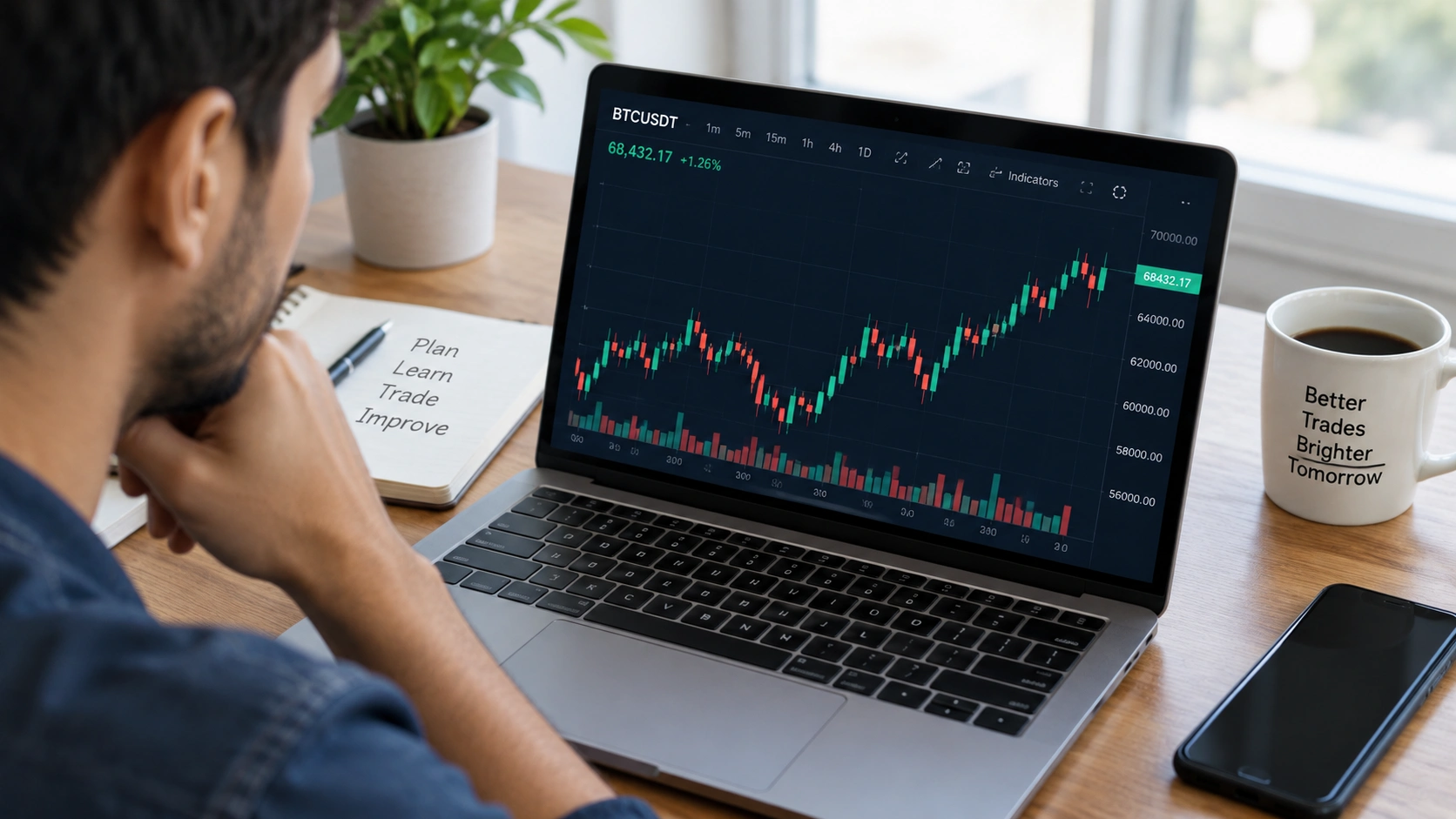
If you are new to financial markets, you may wonder what is futures trading and why so many traders use futures contracts. Futures trading involves buying or selling a standardized contract that agrees to exchange an asset at a predetermined price and date. These contracts can be based on commodities, stock indexes, currencies, interest rates, energy products, and other financial instruments. Unlike traditional investing, futures allow traders to take positions on both rising and falling prices. They also commonly involve leverage, which can increase both potential gains and losses. Understanding how contracts, margin, settlement, leverage, and risk management work is essential before placing a trade. This guide explains futures trading in simple terms and walks beginners through the key concepts they need to understand.
What Is Futures Trading?
At its simplest, futures trading means trading standardized agreements to buy or sell an underlying asset at a specified price according to the terms of the contract. The trader does not necessarily need to own the physical asset. Instead, the contract represents an obligation connected to the future price of that asset. Futures contracts are commonly traded through regulated exchanges, where contract specifications such as size, expiration, minimum price movement, and settlement method are established.
For example, imagine a trader believes the price of crude oil will rise. Instead of buying barrels of oil, the trader could purchase an oil futures contract. If the market price increases and the position is closed at a higher price, the trader may receive a profit, before fees and other costs. If the price moves in the opposite direction, the trader can lose money. This basic example shows why understanding what is futures trading requires more than simply knowing that it involves future prices. It is a structured form of derivatives trading with specific obligations and risks.
How Do Futures Contracts Work?
A futures contract has several important specifications that traders should understand before entering a position. These may include the underlying asset, contract size, expiration month, minimum price increment, tick value, trading hours, and settlement method. Because these terms are standardized by the exchange, traders know what they are trading. Some contracts are physically settled, meaning the underlying asset can be delivered according to the contract terms, while others are cash settled.
Consider a simplified index futures example. Suppose an index futures contract is valued at $5 for every index point. If a trader buys the contract when the index is at 5,000 and later closes the position at 5,020, the price difference is 20 points. At $5 per point, the gross change would be $100 per contract before commissions, fees, and other costs. A move in the opposite direction would create a corresponding loss. Real contracts can have very different specifications, so traders should always check the official contract details before trading.
Why Do Traders Use Futures?
Futures markets serve several purposes beyond short-term speculation. Businesses and professional market participants may use futures to manage exposure to changing prices. For example, an airline may be concerned about rising fuel costs, while a producer of a commodity may want greater certainty about future selling prices. Using derivatives to reduce the impact of unfavorable price movements is commonly known as hedging. This is one reason futures markets play an important role in the broader financial system.
Individual traders may approach futures differently. Some use them to speculate on short-term movements in indexes, commodities, currencies, or other markets. Others may use futures to gain market exposure without directly purchasing the underlying asset. However, futures are not automatically safer or cheaper than traditional investments. Their contract specifications, leverage, expiration dates, margin requirements, and potential for rapid losses make them a specialized financial instrument. Anyone researching what is futures trading should therefore understand its practical purpose rather than viewing futures simply as a faster way to make money.
What Is Margin in Futures Trading?
Margin is one of the most important concepts in futures trading. In a futures account, traders generally do not pay the entire notional value of a contract upfront. Instead, they deposit funds to meet the applicable margin requirement. This creates leverage because a relatively smaller amount of capital can control a position with a larger notional value. Margin requirements can vary depending on the contract, broker, exchange rules, market conditions, and position.
Leverage can make relatively small price movements have a significant effect on the trader’s account. For example, if a futures position has a large notional value compared with the trader’s available capital, an unfavorable market move can reduce account equity quickly. If available funds fall below applicable maintenance requirements, the trader may need to deposit additional funds or reduce the position. Understanding initial margin and maintenance margin is therefore essential. Beginners should not interpret margin as a small purchase price for an asset. It is better understood as financial collateral supporting the futures position.
How Does Leverage Affect Futures Trading?
Leverage is a major reason futures markets attract active traders, but it is also one of their biggest risks. Because traders can control a relatively large contract with a smaller amount of capital, profits and losses can accumulate quickly. A market move that appears small when expressed as a percentage may represent a substantial dollar gain or loss when applied to the full contract value.
For example, suppose a trader controls a futures position with a notional value of $50,000 while maintaining substantially less cash as margin. A 2% unfavorable move in the underlying market represents approximately $1,000 in loss before considering fees and other factors. The trader does not lose only 2% of the margin deposited; the price movement applies to the position’s exposure. This is why experienced traders pay close attention to position sizing, available capital, volatility, and stop-loss planning. Anyone learning what is futures trading should treat leverage as a risk-management issue first and a profit opportunity second.
What Are Long and Short Futures Positions?
Futures trading allows participants to potentially benefit from both upward and downward price movements. A trader who expects prices to rise can establish a long futures position. If the contract price subsequently increases and the trader closes the position at a higher level, the difference can result in a profit before trading costs. If the market falls instead, the position can lose value. For more: Online Stock Trading: A Complete Guide for Beginners
A trader who expects prices to decline can establish a short futures position. In this situation, the trader seeks to benefit from a decrease in the contract price. If the contract falls after the short position is established, closing the position at a lower price can produce a gain before costs. However, a rising market can produce losses. The ability to trade both directions is one of the defining characteristics of derivatives markets, but it does not remove risk. Whether a trader is long or short, disciplined risk management remains essential.
What Are the Main Risks of Futures Trading?
Futures trading carries several risks that beginners should understand before using real money. Market prices can move quickly because of economic data, interest-rate decisions, geopolitical events, supply disruptions, corporate developments, or changes in market sentiment. Leverage can magnify the financial effect of these movements. In addition, futures contracts have expiration dates and specific settlement procedures that traders must understand.
Liquidity is another important consideration. Highly traded contracts may generally provide easier entry and exit than less active contracts, but liquidity can vary by product and market conditions. Slippage can occur when the actual execution price differs from the expected price, particularly during fast-moving markets. Trading fees, exchange charges, financing-related costs where applicable, and other expenses can also affect results. A responsible approach to what is futures trading should therefore include risk management, realistic expectations, and a clear understanding that losses can be substantial.
How Can Beginners Start Futures Trading?
A beginner should start by learning how a specific futures contract works rather than immediately placing a live trade. Important information includes the contract’s size, tick value, expiration cycle, margin requirements, trading hours, settlement method, and typical volatility. Reading the broker and exchange documentation can help clarify these details. A trading simulator or paper-trading account can also allow beginners to practice order placement and position management without immediately risking real capital.
Once the mechanics are understood, traders can develop a written trading plan. This may define the markets they will trade, the maximum amount they are willing to risk, entry and exit conditions, and rules for reducing positions after unexpected market movements. Beginners should also understand different order types, including market, limit, and stop orders, because execution can differ substantially between them. Learning concepts such as futures contracts, margin trading, derivatives, and risk management can provide a stronger foundation before moving from simulated trading to a live account.
Futures Trading vs. Traditional Investing
Futures trading differs from buying and holding an asset such as an individual stock or exchange-traded fund. A stock investor generally purchases an ownership interest in a company, while a futures trader enters into a derivative contract whose value is linked to an underlying asset or financial benchmark. Futures contracts also have defined specifications and expiration cycles, although traders can often close positions before expiration.
Another major difference is leverage. A traditional investor buying an asset with cash may have exposure limited by the amount invested, while a futures trader can obtain substantially larger notional exposure relative to the funds posted as margin. Futures can therefore provide capital efficiency, but they also create a greater potential for rapid losses. The appropriate choice depends on the person’s objectives, experience, risk tolerance, and understanding of the instrument. There is no universal approach that suits every market participant. Beginners should understand these structural differences before deciding whether futures belong in their trading strategy.
Common Mistakes Beginners Should Avoid
Many new futures traders focus heavily on predicting whether prices will rise or fall and overlook the mechanics of managing a position. One common mistake is taking a position that is too large for the available account capital. Because leverage can amplify losses, even a relatively ordinary market move can create significant financial pressure. Another mistake is entering a trade without knowing the contract’s tick value, expiration date, or margin requirements.
Emotional decision-making can create additional problems. Traders may increase a losing position because they expect the market to reverse, move a stop farther away, or trade excessively after a loss. A more structured approach involves deciding risk parameters before entering a position and following those rules consistently. Keeping a trading journal can also help identify repeated mistakes. For anyone learning what is futures trading, the goal should not be to find a perfect prediction system. It should be to understand the market, control exposure, and make decisions based on a clearly defined process.
Frequently Asked Questions
What is futures trading in simple words?
Futures trading involves buying or selling standardized contracts linked to an asset or financial benchmark at agreed contract terms. Traders can potentially profit from rising or falling prices, but losses are also possible.
Is futures trading good for beginners?
Futures can be complex for beginners because they involve leverage, margin, contract specifications, and potentially rapid losses. Learning the mechanics and practicing with a simulator can help build familiarity.
Can you lose more money than you deposit in futures?
Depending on the account structure, contract, broker, and market movement, losses can potentially exceed the initial margin posted. Traders should understand their broker’s risk policies and maintain adequate capital.
What can you trade with futures?
Futures contracts are available on various markets, including commodities, stock indexes, currencies, interest rates, and other financial instruments. Availability and contract specifications depend on the exchange.
How much money do you need to trade futures?
There is no single amount that applies to every futures market. Requirements depend on the contract, broker, margin rules, and account type. Traders should consider risk capital rather than focusing only on the minimum margin.
Conclusion
Understanding what is futures trading starts with recognizing that futures are leveraged derivative contracts rather than ordinary investments. Traders can take long or short positions and gain exposure to markets such as commodities, stock indexes, currencies, and interest rates. At the same time, margin and leverage can make losses occur quickly, making position sizing and risk management especially important.
For beginners, the best starting point is education rather than rushing into a live trade. Learn how contracts work, understand margin and settlement, practice with a simulator, and create clear rules for managing risk. You can also explore related topics such as technical analysis for beginners, risk management in trading, and paper trading to build a broader understanding of financial markets before committing real capital.
1 Comment