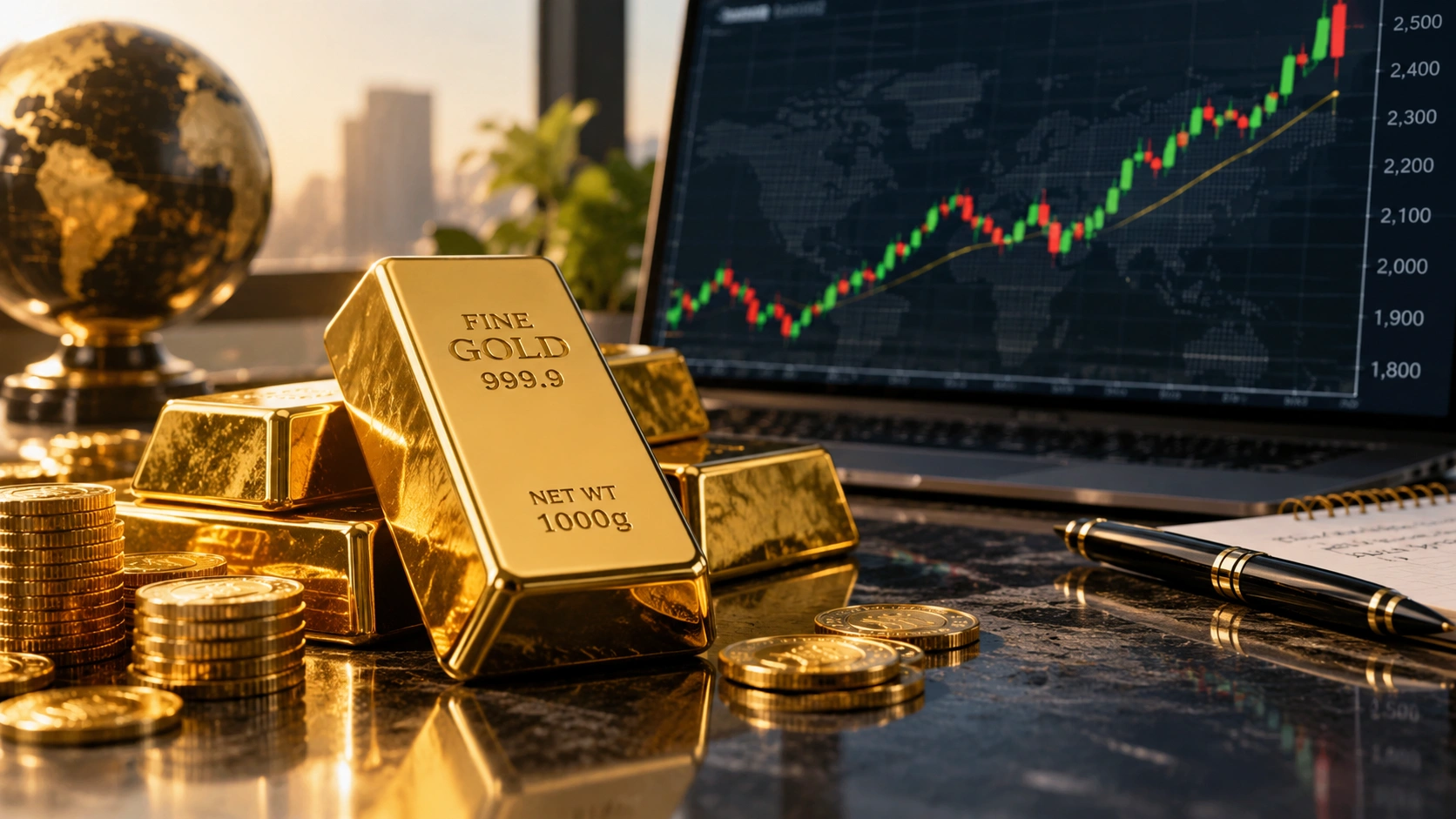
The XAUUSD price shows the value of gold against the US dollar and is one of the most closely followed instruments in global financial markets. XAU represents one troy ounce of gold, while USD represents the US dollar. When traders discuss XAUUSD, they are looking at how many US dollars are needed to buy one ounce of gold. The market can move quickly when interest-rate expectations, Treasury yields, the dollar, inflation, or geopolitical risks change. For beginners, understanding these factors is more useful than simply trying to predict whether gold will rise or fall next.
What Is the XAUUSD Price?
The XAUUSD price represents the market value of one troy ounce of gold in US dollars. For example, if XAUUSD trades at $4,400, the quoted market price indicates that one troy ounce of gold is worth about $4,400. This is generally associated with the international spot gold market and differs from the retail price of physical gold, which can include dealer premiums, taxes, manufacturing costs, and other charges.
Gold has a unique position in financial markets because it is both an investment asset and a physical commodity. Investors may use it for diversification, wealth preservation, or protection during periods of uncertainty. The World Gold Council identifies economic expansion, risk and uncertainty, opportunity cost, and market momentum as four major groups of factors influencing gold performance. These forces can interact, meaning the XAUUSD price may respond to several developments at the same time.
Why Does the XAUUSD Price Move?
One of the most important influences on the XAUUSD price is the outlook for US interest rates. Gold does not pay interest, so investors compare its potential benefits with assets such as government bonds that can provide yields. When yields rise, the opportunity cost of holding gold can increase. When yields decline, gold may become relatively more attractive. However, this relationship is not automatic because market expectations, economic conditions, and investor positioning can change the response.
The US dollar is another major influence because gold is quoted internationally in dollars. A stronger dollar can make gold more expensive for buyers using other currencies, while a weaker dollar can support its relative affordability. Recent market activity showed this relationship clearly. On September 1, 2026, gold fell as Treasury yields and the dollar strengthened, while on September 2, gold rebounded as both eased from recent highs.
XAUUSD and US Interest Rates
Interest-rate expectations can have a powerful effect on gold because they influence bond yields, currency values, and investor behavior. When markets expect tighter monetary policy, Treasury yields and the dollar may strengthen, potentially putting pressure on gold. Conversely, expectations for lower rates can reduce yields and weaken the dollar, creating a more supportive environment for gold. The World Gold Council notes that changes in monetary-policy expectations can become particularly important when markets move from one policy stance to another.
Recent September trading provides a useful example. On September 3, 2026, gold rose more than 2% after Federal Reserve Governor Christopher Waller’s comments reduced expectations for an imminent rate increase. Lower Treasury yields and a weaker dollar also supported the move. The following day, stronger-than-expected US employment data pushed yields and the dollar higher, while spot gold declined 1.2% to $4,419.09 per ounce.
How the US Dollar Affects XAUUSD
The relationship between gold and the US dollar is important when analyzing XAUUSD because the pair directly measures gold in dollar terms. If the dollar becomes stronger against other major currencies, gold can become more expensive for international buyers. If the dollar weakens, gold can become relatively cheaper for overseas investors. This can influence demand and contribute to changes in the quoted XAUUSD price, although the relationship can vary depending on broader market conditions. For more: Fair Value Gap: A Simple Guide for Traders
Traders should therefore avoid using the dollar as a standalone signal. Gold can rise even when the dollar is firm if investors are concerned about geopolitical risks or financial instability. The World Gold Council explains that risk, uncertainty, opportunity cost, and momentum can all contribute to gold’s performance. In 2026, geopolitical risk and changes in investor positioning have been significant contributors to gold’s market behavior, showing why several factors should be considered together.
Economic Data and the XAUUSD Price
US economic data can create sudden movements in the XAUUSD price because important releases can change expectations for Federal Reserve policy. Traders commonly monitor inflation reports, employment data, consumer spending, economic growth figures, and central-bank communications. A surprisingly strong economic report may increase expectations for higher interest rates, while weaker data can sometimes encourage expectations for easier monetary policy. The resulting move in gold depends on how the actual data compares with what financial markets had already expected.
Employment data is particularly important because it provides clues about the strength of the US economy and potential monetary-policy decisions. On September 4, 2026, US nonfarm payrolls increased by 162,000 in August, above forecasts of 56,000. Treasury yields and the dollar subsequently moved higher, while spot gold fell. This example demonstrates why traders should watch the economic calendar when analyzing XAUUSD instead of relying only on technical chart patterns.
Geopolitical Risk and Gold
Gold is often viewed as a safe-haven asset, so geopolitical uncertainty can influence demand. During periods of conflict, financial stress, or heightened uncertainty, investors may seek assets they believe can help diversify portfolio risk. This does not mean gold automatically rises whenever tensions increase, because higher oil prices, inflation concerns, stronger yields, and a stronger dollar can create opposing forces.
The 2026 market has demonstrated this complexity. The World Gold Council reported that elevated geopolitical risk was an important contributor to gold’s first-half performance, while investor positioning and profit-taking also influenced price movements. More recently, tensions involving the United States and Iran have contributed to volatility across currencies, bonds, oil, and gold. Therefore, geopolitical news should be analyzed alongside yields, the dollar, and interest-rate expectations when evaluating XAUUSD.
How to Read an XAUUSD Chart
Reading an XAUUSD chart begins with identifying the broader price structure. A series of higher highs and higher lows generally indicates upward momentum, while lower highs and lower lows may indicate downward pressure. Traders can also identify support and resistance zones where price has previously struggled to move through or has repeatedly reversed. These levels can provide useful context when combined with broader market information.
Technical indicators can add another layer of analysis, but they should not be treated as guaranteed forecasting tools. Moving averages can help identify trends, while momentum indicators can provide additional information about buying or selling pressure. Recent gold trading also shows why technical levels matter: on September 1, gold’s decline was intensified after the metal moved below its 200-day moving average near $4,528, triggering additional technical selling.
XAUUSD Price and Market Volatility
XAUUSD can experience substantial volatility when major financial news reaches the market. Price movements may accelerate around Federal Reserve decisions, inflation reports, employment figures, or unexpected geopolitical developments. This volatility creates opportunities for active traders but also increases risk. A market that moves hundreds of dollars per ounce over a relatively short period can produce significant gains or losses when leverage is involved.
Recent price action illustrates this clearly. Gold fell to around $4,342.20 on September 1 before recovering above $4,376 on September 2 and then climbing to about $4,488.54 on September 3. These movements occurred within a few trading sessions as expectations around rates, yields, and the dollar changed.
How Beginners Can Analyze XAUUSD
Beginners should focus on understanding why the XAUUSD price moves rather than attempting to predict every short-term fluctuation. A practical approach is to begin with the overall trend, identify important technical levels, and then review major fundamental drivers. Checking the US dollar, Treasury yields, Federal Reserve expectations, and upcoming economic releases can provide valuable context before making a trading decision.
Risk management is equally important because gold can move quickly in either direction. Traders should understand leverage, position size, spreads, stop-loss orders, and their broker’s contract specifications before committing real money. It is also useful to practice with historical charts or a demo account before taking larger positions. A good analysis cannot remove market risk, but disciplined risk management can help prevent one unexpected movement from causing excessive losses.
XAUUSD Price Outlook and Key Factors to Watch
The future direction of XAUUSD will depend on how several major forces develop. Traders are likely to continue watching Federal Reserve policy, US inflation, employment data, Treasury yields, the dollar, geopolitical conditions, and investor positioning. The World Gold Council’s 2026 outlook emphasizes that gold responds to the interaction of economic growth, uncertainty, opportunity cost, and momentum rather than to a single market variable.
Current conditions show why a flexible outlook is important. Gold has recently moved sharply in response to changing expectations for Federal Reserve policy. Lower yields and a weaker dollar helped gold rally on September 3, while stronger US jobs data pushed yields and the dollar higher and pressured gold the next day. For anyone following the XAUUSD price, monitoring these relationships can provide a clearer picture than relying on a single price target or prediction.
Frequently Asked Questions
What does XAUUSD mean?
XAUUSD is the market quotation for gold against the US dollar. It generally shows how much one troy ounce of gold is worth in US dollars. The pair is widely followed by traders, investors, financial institutions, and analysts because gold and the US dollar are major global markets.
What affects the XAUUSD price?
The XAUUSD price can be affected by US interest rates, Treasury yields, the US dollar, inflation expectations, economic data, geopolitical risk, investor positioning, and broader market sentiment. These factors can work together or against each other, which is why gold does not always respond in the same way to one particular event.
Why does XAUUSD move so quickly?
XAUUSD can move quickly because gold is highly sensitive to changes in financial-market expectations. A Federal Reserve statement, employment report, inflation release, or geopolitical development can quickly change expectations about interest rates, the dollar, and bond yields, creating significant buying or selling pressure.
Is XAUUSD the same as physical gold?
XAUUSD represents the international market quotation for gold in US dollars, while physical gold includes products such as coins, bars, and jewelry. Physical gold can have additional costs, including dealer premiums, manufacturing charges, taxes, storage costs, and delivery expenses, depending on the product and location.
Is XAUUSD good for beginners?
XAUUSD can be useful for learning about financial markets, but trading it requires careful risk management. Gold can experience sharp price movements, particularly around major economic announcements. Beginners should learn how leverage, spreads, position sizing, and stop-loss orders work before considering live trading.
Conclusion
The XAUUSD price reflects the value of gold against the US dollar and responds to a combination of monetary policy, Treasury yields, currency movements, economic data, geopolitical developments, and investor sentiment. Recent September 2026 price action shows how quickly gold can change direction when expectations for Federal Reserve policy and the US dollar shift.
For readers following gold, the most useful approach is to combine fundamental and technical analysis rather than depending on one indicator or forecast. Keep an eye on the Federal Reserve, US economic data, Treasury yields, the dollar, and major geopolitical developments. For deeper research, related topics such as gold trading strategies, US dollar analysis, and technical analysis indicators can provide useful next steps.